Tech review: Let the robots take over ... your lawn care
Published in Business News
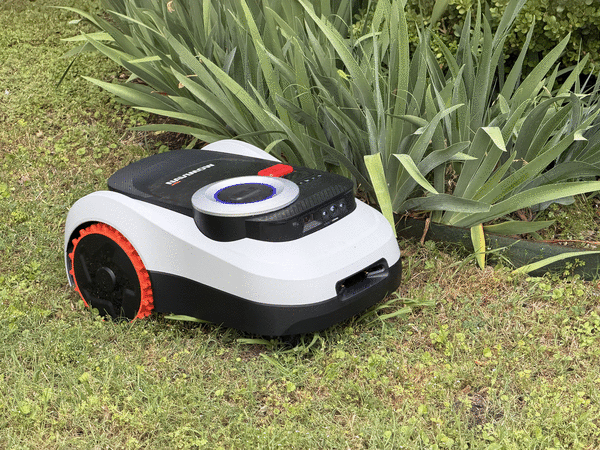
My last review was a robot vacuum. This week, we let the robots outside to let it cut the grass.
Years ago, my first experience with robot mowers required a wire to be buried around the perimeter of the yard. When the manufacturer offered to come have a wire buried at my house for testing, it was more than I wanted to deal with, as I’m a renter.
A few years later, I tried out a robot mower called the Blade, from power station manufacturer EcoFlow. It used GPS to map out the yard, and it did a decent job. Unfortunately, setup and mowing was harder than it should have been, and they stopped making and selling the mower after about a year.
This year, I’ve been testing the latest in robot mowing from Segway, the company most people know for mobility scooters. The company makes a few different mower models for different sized yards and different terrains.
I’ve been testing the Segway Navimow i215 Lidar ($1,599, navimow.com), a rear-wheel-drive model that relies on Lidar and cameras for very accurate navigation, even at night.
Features
The i215 mows without wires, and there is no external GPS antenna. The Lidar and cameras capture a detailed map of your yard and once you set it up, mowing is as simple as pressing a button. The system scans up to 200,000 points per second to build a very detailed picture of your yard.
The mower can automatically map a simple yard by itself, but it really shines when you take the time to show it around first.
It uses a single blade platter that houses six small razor blades to cut the grass.
The cutting width is just 8.66 inches, so it makes a lot of trips back and forth to mow your yard.
The mower is designed to cut a yard up to 0.37 acres. There are different models with larger batteries to mow larger yards.
It operates at just 59 decibels (very quiet), and the whole thing is IP66 water resistant, which means it is dust-tight and can handle powerful water jet sprays from any direction.
I’ve had it sitting in my back yard for a month and it’s been exposed to heavy rain at least half a dozen times, and it performs like a champ. The mower lives on a charging pad when it’s not in use. Segway sells a small cover for the charging pad that looks like a tiny carport, but I didn’t get one to test. The i215 didn’t seem to mind the weather at all.
It takes just over two hours to charge and it can mow for about 160 minutes before it returns to the base for recharging.
It works in conjunction with an app on your phone that helps you map and customize your mow zones. It lets you set the mowing parameters like the blade height (0.8 inches to 4 inches) and set schedules for automatic mowing.
Setup
You’ll need to select a good spot for the charging base with about 12 inches of clearance on either side. I have ours in a portion of a flower bed that’s open to the yard. It’ll need to be within reach of electricity, so it may be necessary to run an extension cord to the closest outdoor outlet.
Once the base is placed and plugged in, you sink the provided screw/spikes to secure it and set the mower on it to charge up the battery.
The mower is smart enough to return to the charger during the mowing sessions if the battery gets low. It will recharge and then continue with the task.
Once the mower is charged, you open the app and follow the directions to connect it to your Wi-Fi network and begin to create a map of where you’d like it to mow.
You can ask it to auto map, or you can create a map manually by driving the mower with controls that appear on the phone screen. You steer it around the perimeter of your yard until you get back to the starting point. This is called mapping a zone. You can map multiple zones (like front yard and back yard) and you can show the mower the path you’d like it to take to move between the zones. It will follow your route exactly.
If there’s a gate or fence separating the zones, you can either arrange to open the gate, use an optional automated “doggie door” you mount in your fence or you can pick it up and carry the mower to the other zone (called an isolated zone).
The mower weighs 32 pounds and has a carrying handle on the front to make it not so bad to tote around.
In use
The beauty of a robot mower is setting it to work on a schedule.
You don’t want the robot to mow really tall grass, as the razor blades work best in just taking a little off the top, so I did one last mow with my push mower and then set the i215 to mow every few days. Once you get the yard mapped, you can set the mower to run at any time, even the middle of the night. It is so quiet, your neighbors will have no idea when it is working.
I’ve learned to wait until the morning dew is dried off the grass, as wet clippings will stick to the mower.
The Segway mowers work great, but they won’t exactly end your yard-work commitment.
Because the blade is under the middle of the mower, they can’t cut out to the edge, so there’s always a small swath of uncut grass that it will leave, like up next to raised beds or retaining walls or along the curb. So, while the i215 does a great job on the lawn, you’ll still need to go over the edges with a string trimmer or edger.
With the right yard, the Navimow i215 Lidar can cut your yardwork time down considerably.
This is one of those gadgets that makes me smile every time I see it working. This is what we were promised when we watched cartoons like "The Jetsons."
The future is here and it wants to help you mow.
©2026 Tribune Content Agency, LLC.










Comments