Best Buy makes room for Meta's AI glasses as privacy debate grows
Published in Business News
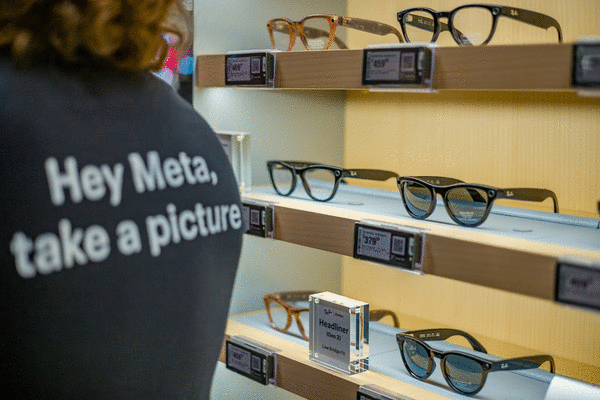
ROSEVILLE, Minnesota — Slipping on Meta’s AI-powered glasses at Best Buy’s new in-store hub, shoppers can navigate to the nearest coffee shop, view text messages or translate menus in real time with a voice command or subtle hand gesture.
But as the retailer rolls out dozens of Meta Labs hubs, privacy concerns around glasses and other AI products are growing. Critics have raised alarms about the potential to secretly record people and Meta’s work on facial-recognition technology.
Best Buy has teamed up with Meta, the parent company of Facebook and Instagram, to open about 50 shop-in-shops across the country. The spaces feature Meta’s smart glasses and virtual reality headsets, with employees trained to demonstrate the products and answer shoppers’ questions.
The Roseville store — the only Meta Lab in Minnesota — opened July 6.
The partnership reflects Best Buy’s broader strategy of turning stores into places where customers can test emerging technology before deciding whether to buy it, Chief Revenue Officer Patrick McGinnis said.
“AI glasses are by and large a new experience for most customers,” McGinnis said in a phone interview. “Understanding all that they can do, understanding the AI features and things like live translation are things that really need to be brought to life in a store.”
Yet whether consumers embrace the devices may depend as much on trust as the technology itself.
“There is this general concern that needs to be balanced, and in some cases it is the market — the people — that are going to decide what the outcome eventually will be in terms of social acceptance,” said Soumya Sen, associate professor of information and decision sciences at the University of Minnesota’s Carlson School of Management.
Google first introduced consumers to the concept of smart glasses more than a decade ago, but the product never caught on.
When the original Google Glass prototype debuted in 2013, early adopters in Minneapolis said strangers frequently stopped them to ask about the futuristic-looking device, while privacy concerns surfaced almost immediately because users could discreetly take photos and record video.
The technology’s limited capabilities, bulky design and $1,500 price tag ultimately kept it from reaching the mainstream.
Today’s AI glasses are far more discreet, resembling conventional eyewear while offering features such as real-time translation, hands-free photography and AI-powered assistance, said Seth Ketron, an associate marketing professor at the University of St. Thomas who studies retail technology and consumer behavior.
All of Meta’s smart glasses include built-in cameras with an LED light that illuminates while recording to alert people nearby.
But some early users found workarounds, including placing electrician’s tape over the LED or prying open the glass panel and drilling out the light. In response, Meta said in early July the company will disable the glasses’ recording functionality if the LED has been tampered with.
Meta has also developed facial-recognition technology for its smart glasses, though the feature has not been released to consumers, according to reporting by Wired. The technology could identify people captured by the glasses’ camera and notify the wearer when it recognizes someone.
Privacy advocates say such technology could expand surveillance and raises questions about consent. Meta has said it is still exploring the feature and has not decided whether to release it.
In many cases, “recording people without their consent is unethical,” Ketron said, “even more so in situations where privacy is paramount, like medical settings.”
Because the technology is built into a pair of glasses, it may also be more difficult to restrict than smartphones or computers, Ketron said. He added the devices could pose academic integrity concerns if students use them to cheat on exams.
McGinnis acknowledged privacy is a common topic during product demonstrations. He said Best Buy trains employees to explain how the devices work while addressing customers’ concerns.
“Our role in that is to really help explain how they work,” McGinnis said. “And also have empathy for the customer and make sure that they feel heard, that their concerns are heard, and make sure that they’re getting a good match if they choose to ultimately step into new technology.”
Meta and Best Buy are betting AI glasses will become more common, though widespread adoption is far from certain.
Ketron said the category has advantages over virtual reality headsets because consumers are already comfortable wearing glasses, and the latest devices closely resemble traditional eyewear. But their relatively high price and lingering concerns about AI could slow widespread adoption.
“People may not see enough value in them yet to adopt them en masse,” he said. “All that said, sales are going up, so people do appear to be adopting them.”
EssilorLuxottica, which makes the Ray-Ban Meta, Oakley Meta and other Meta glasses, said it sold more than 7 million pairs last year, up from 2 million pairs in 2023 and 2024 combined.
Sen, the U of M professor, said the glasses could prove useful in workplaces by supporting real-time customer interactions and assisting employees in labor-intensive jobs. The technology also could benefit workers with disabilities, particularly those who are deaf or hard of hearing.
But Sen said broader adoption will depend on whether consumers see enough value in the devices. New technologies typically gain traction with early adopters before spreading to the broader public.
By opening these spaces inside Best Buy stores, the companies are making the glasses easier for consumers to try, which could encourage people to consider a product that might otherwise seem like another gadget to carry.
Meta also faces stiff competition from smartphones, Sen said. The company will have to persuade consumers to rely on its software ecosystem over Apple’s to become a true replacement. Meta glasses, for example, cannot send iMessages and instead rely on Meta’s Messenger and WhatsApp platforms.
Incoming Best Buy CEO Jason Bonfig previously told the Minnesota Star Tribune that AI will create “a tremendous amount of new products and services for customers,” while also reshaping how people shop.
McGinnis said Best Buy has a history of bringing emerging technologies into stores before they reach the mainstream, pointing to 3D printers and the first generation of Meta Ray-Ban glasses.
“Oftentimes we find ourselves really tracking as a new technology or a new product is nearing readiness for the market,” he said. “We’ll sometimes put something into a retail environment that is really, really new and is not necessarily fully proven yet.”
©2026 The Minnesota Star Tribune. Visit at startribune.com. Distributed by Tribune Content Agency, LLC.










Comments