Kashkari: It's time for the Fed to raise interest rates
Published in Business News
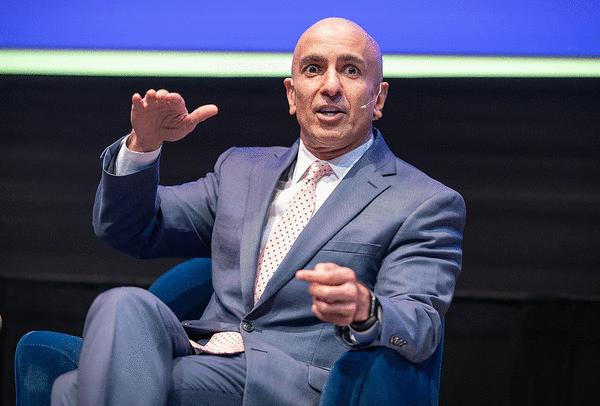
Federal Reserve Bank of Minneapolis President Neel Kashkari wants the Fed to start raising interest rates as inflation stays high.
Kashkari was one of three regional bank presidents to oppose a Federal Open Market Committee (FOMC) decision Wednesday to leave rates unchanged, saying the central bank should instead raise rates a quarter point.
“I asked for a good family fight, and I got one,” Fed Chair Kevin Warsh said at a news conference after the meeting, noting board members agreed on the Fed’s ability — and responsibility — to stabilize prices.
“I came out of that meeting even more confident that this is the right team to win the battle against high inflation,” he said.
The FOMC, which sets monetary policy, has held rates between 3.5% and 3.75% since December.
Interest rates are the Fed’s main tool to balance its dual mandate of low unemployment and stable prices. When inflation exceeds 2%, the FOMC raises rates to slow the economy; when unemployment is high, it lowers rates to kickstart growth.
In a statement Friday, Kashkari noted that inflation has been elevated relative to that 2% target for more than five years. He wrote that “monetary policy does have an important role to play in addressing a series of successive supply shocks that might lead to entrenched higher inflation.”
“If inflation remains elevated, in my view, a potential series of small policy moves would be better than waiting and eventually concluding that even bolder actions were necessary,” he wrote. “On the other hand, if inflation durably fades, a strategy of small policy steps would allow the FOMC to slow or pause subsequent adjustments without unnecessary impact on the real economy.”
The U.S. Bureau of Economic Analysis released data Thursday showing the Fed’s preferred inflation gauge rose 3.7% year-over-year in June. “Core” inflation, which excludes volatile food and energy prices, was up 3.3%.
“The Fed’s central dilemma is that the inflation overshoot is largely the result of three overlapping supply shocks, which the Fed has little control over,” Michael Pearce, chief U.S. economist at Oxford Economics, wrote in a Wednesday research briefing. “The pass-through of tariffs, the inflationary effects of the AI buildout and the broader inflationary effects of higher energy prices are all keeping core inflation significantly above the 2% target.”
Disagreement among monetary policymakers “appears to reflect differing views on the extent to which [those] three supply shocks hitting the economy will cause lasting upward pressure on inflation,” Pearce wrote.
Kashkari previously told the Star Tribune he was confident at the beginning of 2026 that inflation was falling and the FOMC would soon be able to start cutting rates. That changed when the U.S.-Israeli war against Iran began in late February, pushing inflation back up.
At the April FOMC meeting, the same three regional bank presidents who dissented Wednesday — Kashkari, Cleveland Fed President Beth Hammack and Dallas Fed President Lorie Logan — said they wanted the Fed to stop signaling publicly that it’s leaning toward a future rate cut.
In an essay published May 1, Kashkari wrote the FOMC may need to raise rates multiple times if the war drags on and the Strait of Hormuz stays closed. Iran’s blockade of the strait remains in place, with limited traffic allowed through the key shipping route.
The 12-member FOMC includes the seven-member Board of Governors, the Federal Reserve Bank of New York president and four other regional presidents who serve rotating one-year terms.
The committee’s next meeting is scheduled for September.
©2026 The Minnesota Star Tribune. Visit at startribune.com. Distributed by Tribune Content Agency, LLC.





Comments