ICE reverses plan to detain migrants in mega-warehouses
Published in News & Features
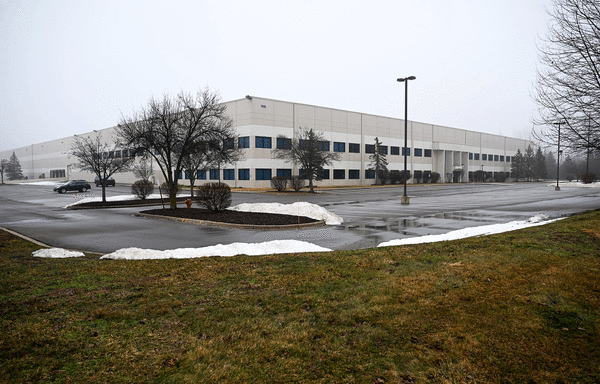
The Department of Homeland Security is backing away from a controversial plan to turn empty warehouses into immigration detention centers and will keep relying largely on existing jails run by private contractors and state and local partners.
The decision marks a sharp retreat from one of former Homeland Security Secretary Kristi Noem’s signature immigration initiatives, a proposal that sought to create a network of government-owned detention facilities capable of holding nearly 100,000 immigrants awaiting deportation, with some set to start operating this year.
“From day one, DHS has remained singularly focused on removing the worst of the worst criminal illegal aliens from the United States and is always evaluating the best methods to do so,” the agency said in a statement to Bloomberg News on Thursday.
“These heinous criminals, once arrested, should be removed at lightning speed, not housed on American soil at the taxpayer’s expense. DHS is moving swiftly to utilize EXISTING detention space with our state and county partners.”
The shift comes after Homeland Security Secretary Markwayne Mullin launched a review of the department’s detention strategy following Noem’s departure earlier this year.
Internal documents obtained by the New York Times show Immigration and Customs Enforcement plans to dispose of at least seven of the 11 warehouses it purchased for more than $700 million, either by selling them or transferring them to other federal agencies.
The move leaves in doubt the future of the $38 billion so-called ICE Detention Reengineering Initiative. As part of that plan, ICE had already spent $1 billion buying the 11 warehouses across the country as part of an effort to consolidate a patchwork system of more than 200 detention facilities — most operated by contractors or local governments — into a smaller network of 34 government-owned sites.
The administration appears to be moving forward with four of the warehouse projects, according to the documents reviewed by the New York Times, though it remains unclear why those facilities were spared. ICE is also exploring the purchase of existing detention centers from private prison companies it already uses, the newspaper reported.
Backers of the ICE Detention Reengineering Initiative argued the purchases would dramatically expand holding capacity and help accelerate President Donald Trump’s mass deportation agenda.
But the plan also quickly ran into resistance. Communities across the country raised concerns about turning industrial buildings into large-scale detention centers, while lawsuits challenged whether federal officials had properly reviewed the environmental impacts of the projects.
The DHS’s internal watchdog began an investigation into the warehouse-to-detention program in May to see if it meets “its operational need in a cost-effective manner.”
Republican and Democratic elected officials alike objected to proposed facilities in their communities, and critics questioned whether warehouses could be safely converted into places to house thousands of people. The obstacles slowed projects in multiple states, including Maryland, New Jersey, Michigan, Utah and Georgia.
The fate of the warehouses already acquired remains uncertain. Contracts worth more than $1.3 billion to convert and operate facilities in Maryland and Arizona were awarded earlier this year. Federal contracting records show the government has spent about $10 million on the Maryland project and nearly $4 million on work at the Arizona site.
Social Circle, Georgia officials said Thursday that Representative Mike Collins, a Republican running for one of Georgia’s Senate seats, had informed the city that DHS was no longer pursuing an ICE detention facility there.
The proposed facility, which was expected to hold as many as 10,000 detainees and rank among the nation’s largest immigration detention centers, drew strong opposition from residents and local officials who said it would overwhelm infrastructure and change the character of the small Georgia city.
“It is our understanding that the property could be sold if there are no other federal agencies that express interest in the property,” according to the statement on Facebook.
“The city is hopeful that the property will ultimately return to the local tax base and once again contribute to the economic vitality and long-term success of the Social Circle community.”
_____
©2026 Bloomberg L.P. Visit bloomberg.com. Distributed by Tribune Content Agency, LLC.






Comments