Pritzker says Illinois ethics panel should release Harry Benton harassment report amid Welch office scrutiny
Published in News & Features
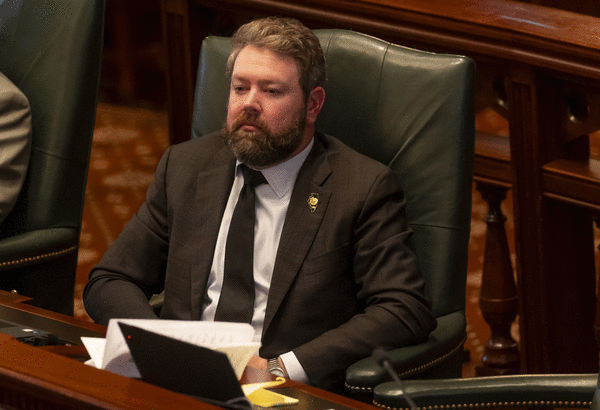
Democratic Gov. JB Pritzker called on members of the state Legislative Ethics Commission to publicly release an inspector general’s investigative report of misconduct involving disgraced former state Rep. Harry Benton for participating in a “clear pattern of conduct” that included sexual harassment.
Pritzker’s call for the report’s release came as members of the Illinois House Democratic majority, particularly women within the caucus, deliberated the details revealed in a Tribune investigation over how House Speaker Emanuel “Chris” Welch’s office dealt with the Benton situation — including his office’s knowledge of previous harassment allegations filed by a now-former Benton staffer three years ago.
The Tribune investigation found that in April 2023, the Benton staffer reported to Welch’s office a series of incidents of harassing behavior, many of a sexual nature, that she experienced from the lawmaker, but Benton wasn’t interviewed by the speaker’s top staff until three months later. That was after the woman had already quit her job, saying she feared for her mental health. The former staffer told the Tribune that she had no contact with Welch’s office after the interviews and that Benton was not disciplined at the time.
Earlier this month, Benton, a Plainfield Democrat, resigned his seat and withdrew his bid for reelection after Legislative Inspector General Michael McCuskey issued a private report of his investigation of the lawmaker to the speaker’s office. The report was in response to a complaint Welch’s office filed earlier this year regarding Benton’s behavior.
While neither the report nor the complaint have been made public, the Tribune investigation found that the complaint was filed after an incident earlier this year in which a female lobbyist ran into Benton at a bar in Chicago’s River North neighborhood. The lobbyist told the Tribune that Benton showed her pictures on his phone of women he claimed to have slept with and made a series of lewd comments to her.
The former Benton staffer’s experience — and the years of inaction that followed — raise pointed questions about whether Welch’s office violated state and internal sexual harassment protocols it was legally required to follow, and whether a lawmaker whose conduct had been reported to leadership was allowed to continue for years without consequence until another woman had had enough.
The Tribune interviewed both women but is not identifying them because they requested anonymity and are victims of sexual harassment.
Separately, the Tribune investigation found documents showing that Welch responded to social media posts made by the former Benton staffer, who had once served as an intern in the speaker’s office, in ways she said made her feel “uncomfortable.”
Welch’s office issued a pair of statements defending its handling of the allegations involving Benton, saying “appropriate action was taken” at all times — though the statements did not disclose what, if any, disciplinary action was taken in 2023. The speaker’s office also said the former staffer was not an employee of Welch’s office at the time of their social media interactions and that “their cordial relationship pre-dated Representative Benton, with dialogues spanning from advice, support, and even the complainant offering tips for the Speaker and his wife’s travel itinerary.”
The Tribune story appeared online Friday morning and later that day Pritzker’s office, in a statement, said the governor had not seen the legislative inspector general’s report “but supports transparency and accountability and believes the release of the report would be in the best interest of the public.”
“The Governor commends individuals who share deeply personal experiences and help shed light on inappropriate and unacceptable workplace conduct, especially in public service,” the statement from Pritzker’s office said. “He believes Illinoisans deserve the highest standards and ethics from their elected representatives, who all share the critical responsibility of maintaining safe working environments free of harassment.”
In a statement, the Democratic Party of Illinois said its leaders were “learning of this reporting with the rest of Illinois, are digesting the details in real time, and have not seen any of the Inspector General’s report.”
“DPI maintains our belief that elected representatives have a responsibility to hold themselves to the highest behavioral standards to maintain safe workplaces,” the party’s statement said. “Transparency is critical in this moment to honor the bravery of those who speak out and the trust of the general public.”
It was clear in speaking to some lawmakers that the Tribune report threatened to reignite the turbulence that a #MeToo scandal in 2017 and 2018 created and prompted a revolt of Democratic women against longtime House Speaker Michael Madigan for failing to act promptly against a top aide accused of harassment. That scandal severely weakened Madigan’s grip on power and eventually led to Welch succeeding him as speaker in 2021, despite his own controversial past involving personal relationships with women.
“I’m upset, and I’m disturbed that this is still the behavior that we’re dealing with 10 years now after kind of we had gone through a very similar #MeToo movement,” said state Rep. Margaret Croke of Chicago, who is the Democratic nominee for state comptroller. Croke was one of 19 House Democrats who refused to back Madigan’s reelection bid for speaker in 2021. Madigan was later imprisoned on unrelated federal corruption charges.
Croke said that what “really hit me (was) as someone who kind of grew up in government and grew up in politics, where I was that young female staffer — that if this had happened to me at this level, would I have gone on to other campaigns, to being a state rep, to running for comptroller? Those are all questions that I am kind of grappling with right now.”
Croke said she appreciated Welch “taking action to remove Harry (Benton) and to ask for his resignation and to push him to remove his name from the ballot.” But of supporting Welch’s leadership in the future, she said, “I want to see how this plays out.”
“Someone who is entrusted with this level of power, or constituents believe in them to do the right thing … there’s a certain level that you need to hold yourself to as an elected official and as a public servant,” Croke said about elected officials in positions of power.
Democratic state Rep. Lindsey LaPointe of Chicago, a progressive who also refused to back Madigan’s reelection bid for speaker in 2021, said the Tribune article “raises questions about the practical application of policies and procedures for reporting discrimination and harassment within House District Offices and the Speaker’s Office at large.”
“We should all be familiar not only with the reporting mechanisms but, very importantly, the internal protocols for following up on those reports within the Speaker’s Office and within Human Resources,” LaPointe said in a statement Saturday. “Once more information about this case and how it was handled becomes public, I’m confident that decision makers will focus on accountability and policy and practice change in the interest of workplaces free of discrimination and harassment for everyone. We must do far better to stop harmful behavior more quickly and support victims of discrimination and harassment.”
State Rep. Anne Stava, a Naperville Democrat and another one of the 19 House Democrats who didn’t back Madigan for speaker in 2021, said she has supported Welch, but now “I have some thinking to do on what would make me confident to support him going forward,” given the Tribune article.
“I think Speaker Welch has some thinking to do about the way he interacts with younger women. Because I don’t think he should have put himself in the position that he’s in right now,” she said.
Both Croke and Stava said they believed the legislative inspector general’s report should be released publicly, with appropriate redactions to protect victims’ identities.
“The only qualifier I’ll ever use is that victims should be prioritized, and victims’ preferences should come first, above mine, above yours, above anyone else’s,” Stava said.
Members of the Legislative Ethics Commission, the bipartisan eight-member panel made up of four Democratic and four Republican state lawmakers that reviews inspector general reports, are scheduled to meet Thursday and could vote to make the Benton report public.
Many of the commission members had no comment on the Tribune’s investigation, citing the confidentiality of their work, though one member, Republican Jil Tracy of Quincy, said, without elaborating, that the story “was far worse than the report.”
“My thought was, even before this (article) I was thinking the Republicans would probably vote to release it, and I have to think too that the Democrats would seriously think about it as well,” she said. “I think that everybody’s had enough. The truth is, it’s already out there.”
Tracy said that the details in the Tribune report point to potentially making one change in state law to extend the statute of limitations on what actions an inspector general can investigate to as many as four years from the current one-year limit.
House Republicans, a superminority in the chamber, said the Tribune account was indicative of the failures of House Democratic leadership.
“The reporting released today raises serious questions about what House leadership knew, when they knew it, and whether they acted quickly enough to protect staff,” House GOP leader Tony McCombie of Savanna said in a statement.
“Delays in delivering accountability only protects misconduct. The Benton report should be released, and anyone who failed to uphold their responsibility must be held accountable,” she said. “The culture has not changed and must change; public trust depends on it.”
_____
©2026 Chicago Tribune. Visit chicagotribune.com. Distributed by Tribune Content Agency, LLC.






Comments