After a weekend of gunfire, Minneapolis again searches for solution to summer violence
Published in News & Features
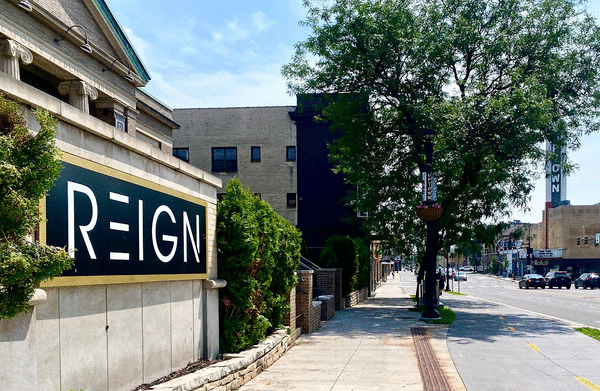
MINNEAPOLIS — One day after a pair of mass shootings killed one person and injured 13 in Minneapolis, Tarik Asbu and Robert Hobot searched for what was left behind.
The Hennepin County library maintenance workers had been called to the Walker Hennepin Library across from the Reign Event Center to clean up. Earlier, investigators spent hours documenting shell casings and interviewing witnesses outside the nightclub in the heart of Uptown.
“It’s been quiet but we’ve had to up security outside the library recently,” Hobot said. Ongoing problems led them to remove a bench to discourage loiterers, he said. “We were called because we were told there was some blood out here but we haven’t seen it.”
They never found any blood. But invisible reminders remained from a weekend that saw gunfire erupt twice, renewing fears about yet another uptick in summertime carnage.
Shortly before 12:30 a.m. Sunday, nine people were wounded by gunfire outside Reign, with two men critically injured, police said.
The second mass shooting occurred late Sunday in the 1800 block of Nicollet Avenue S., where five people were hit by gunfire. Ajoko Gaye, 28, of Minneapolis was killed.
Police say they do not believe the shootings were connected. No arrests have been made, nor has a motive been publicly addressed. Police say they do not suspect gang activity was behind either shooting.
The violence capped another turbulent summer weekend in Minneapolis, where officials have spent months pointing to declining crime statistics after the record violence of the pandemic era. Homicides and shootings remain well below their recent highs, but a string of high-profile shootings in crowded public places has once again shaken residents’ sense of security and put renewed scrutiny on the city’s efforts to curb gunfire.
“Minneapolis experienced another senseless act of gun violence,” Interim Police Chief Bill Peterson said after the Uptown shooting and a second mass shooting later that night. “This was a brazen act of violence in a crowded entertainment district where innocent people were placed at tremendous risk. That is absolutely unacceptable.”
The shootings also drew a forceful response from Mayor Jacob Frey, who called the weekend violence “intolerable” and said the city would work to “hold the perpetrators accountable for these senseless crimes.”
“This is a stark reminder that keeping our streets safe requires every tool available,” Frey said in a statement. He called for continued hiring of police officers, partnerships to arrest and prosecute offenders, and expanded use of technologies such as drones and ShotSpotter.
For city leaders, the challenge is twofold: responding to the immediate violence while trying to prevent it from happening again.
“When it comes to prevention, one of our focuses is trying to get to the root cause,” Minneapolis Community Safety Commissioner Todd Barnette said. “And the city can’t do that alone. That takes partnerships with the county, who provides a lot of the social services, the state, but more importantly, it really does take the community to help with prevention.”
Two miles away from Reign, Sunday evening’s shooting left workers at Net Supermarket near 19th Avenue and Nicollet Avenue shaken.
Inside the store Monday, the lights were out after a power outage, and the business sat largely empty. An employee, who declined to give his name out of fear for his safety, wiped away tears as he explained how two co-workers were shot.
“One of our employees just got married two, two and a half weeks ago. Now he’s injured and hospitalized,” he said. “The other one has like 4 or 5 kids, and he’s the only working man in the family.”
The employee said the violence has hurt both his co-workers and the business.
“Our business has been hard, too, because of the gun violence,” he said. “Then the COVID thing happened. All the crowd that used to be living downtown moved up here. Then all the gun violence and other stuff moved over here too.”
By Monday morning, the emergency vehicles were gone from Hennepin Avenue. Traffic flowed through Uptown as construction crews worked nearby and pedestrians filtered between coffee shops and businesses. For many residents, the neighborhood looked much as it always had — even as conversations centered on what had happened just two nights earlier.
Nicole Luttrell, who recently bought a condo in Uptown after years in Loring Park, said they regularly spend evenings in the neighborhood, including at the late-night arcade UpDown, and rarely feel unsafe.
“I’ve never really encountered anything crazy,” Luttrell said. “I know that there’s some hotspots, as well, by UpDown, but whenever I’ve gone out we haven’t seen anything. I have some friends that live there as well, and they have very rarely had problems.”
Still, Luttrell worries the city too often treats gun violence as someone else’s problem.
“I think they [the city] are trying to depend on, like, a singular group of people when it actually is something that affects all people, and they kind of frame it as it’s just a singular area.”
Peter Lochner, who has lived in Uptown for three years and grew up in south Minneapolis, said he was devastated to wake up Sunday to news of the shooting. But he resisted the idea that one violent night should define a neighborhood he still sees as one of Minneapolis’ cultural centers.
“It was just always cool, and everyone was like, ‘Oh, it’s so dangerous, the guns and whatever,’” Lochner said, adding that he feels like the threat was overblown. “I just never bought into it and it just feels like fear mongering.”
Jerry Hughes was out with friends Saturday night and returned to an apartment near 28th and Emerson only minutes before the gunfire began.
“I was just shocked because we were just roaming. We were at Troubadour then took a pedicab to come back to the apartment,” Hughes said Monday. “Then we heard about it and were like ‘Oh my God, we were just by there.’”
Hughes moved to Minneapolis from Iowa in 1992, when Uptown was one of the city’s signature gathering places. He said he is at times ambivalent when it comes to safety concerns, but ultimately can’t let fear deter him.
“I used to live downtown for years, and from what I’ve seen there with the violence and night clubs it kind of makes me go a little bit like ‘Stay away,’” Hughes said. “I think more people can come and be downtown and don’t let the violence scare you because I love downtown and I love Uptown as well and people don’t need to be scared.”
—Paul Walsh of the Minnesota Star Tribune contributed to this story.
©2026 The Minnesota Star Tribune. Visit at startribune.com. Distributed by Tribune Content Agency, LLC.





Comments