Tropical Storm Bertha strengthens as warnings extend into Florida, NHC says
Published in News & Features
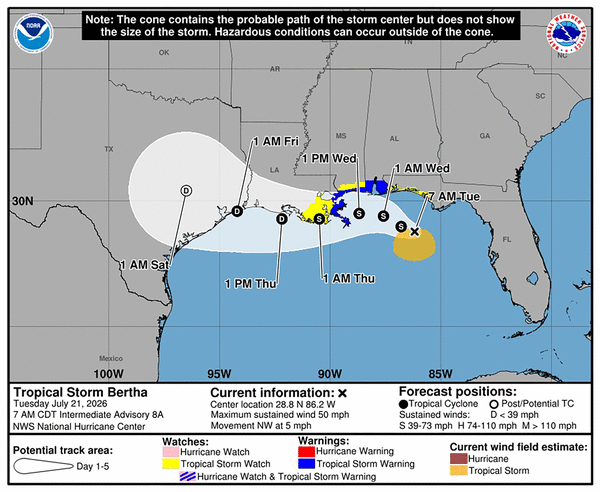
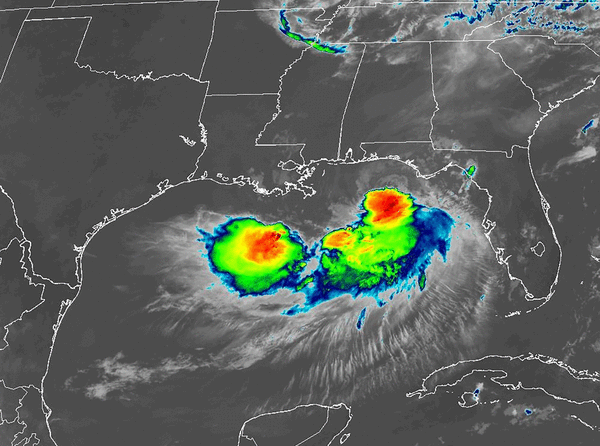
Tropical Storm Bertha strengthened Tuesday as it moved closer to the Gulf Coast, and the National Hurricane Center extended tropical storm warnings into Florida.
As of the NHC’s 2 p.m. EDT advisory, the center of Bertha was located about 90 miles southwest of Panama City and 125 miles southeast of Mobile, Alabama moving northwest at 5 mph with maximum sustained winds of 60 mph and higher gusts.
Tropical-storm-force winds extend outward up to 90 miles from Bertha’s center. A National Ocean Service station in Panama City Beach reported sustained winds of 42 mph and a gust of 49 mph after noon as tropical-storm conditions began lashing the Florida Panhandle.
“Bertha is expected to turn toward the west-northwest and west later today and tonight. Then, a continued westward motion is forecast through the middle of the week,” said NHC senior hurricane specialist Brad Reinhart. “On the forecast track, Bertha will move near or along the northern Gulf Coast during the next several days.”
The NHC extended a tropical storm warning to include seven Florida counties from the Florida-Alabama border east to the Bay-Gulf County line. The warning also extends west from the Florida-Alabama border to the Terrebonne/Lafourche Parish Line in Louisiana.
A tropical storm watch is in effect for west of the Terrebonne/Lafourche Parish Line to the Vermilion/Cameron Parish Line and for metropolitan New Orleans, Lake Pontchartrain and Lake Maurepas.
A storm surge warning that had been in place for parts of the Gulf Coast was discontinued, but the National Weather Service has issued flood warnings for parts of the southeastern Louisiana and Mississippi coastline.
What had been the second tropical depression of the Atlantic hurricane season spun into a named storm by 8 p.m. Monday with 40 mph winds, but had picked up steam by 11 p.m. and intensified further through Tuesday morning.
Reinhart said models show the system is likely at its peak intensity, and should begin to gradually weaken over the next few days.
“Bertha remains an asymmetric tropical storm, with most of the rainfall and the strongest winds occurring to the south and east of the center,” he said. “Strong northeasterly vertical wind shear over Bertha is forecast to persist today and tonight, which should make it difficult for Bertha to strengthen much more.”
Tropical-storm conditions are expected within the warning area later Tuesday and into Wednesday, while conditions are possible in the watch area in Louisiana on Wednesday.
A storm surge of 1-3 feet could hit the Florida coast from Indian Pass to the Aucilla River, while surge could hit 2-4 feet from the mouth of the Mississippi River to the Mississippi-Alabama border, and 1-3 feet from that border to the Alabama-Florida border, Lake Pontchartrain and from the Vermilion/Cameron Parish line in Louisiana to the mouth of the Mississippi River.
In addition, rainfall of 2-4 inches through Thursday, with some areas seeing up to 6 inches, is forecast along the Gulf Coast and adjacent inland locations from western Florida into southern Louisiana, including southern portions of Alabama and Mississippi, with a threat of flash flooding.
Swells along the coast could cause life-threatening surf and rip current conditions.
Short-lived Tropical Storm Arthur was the season’s first named storm that developed in the Gulf and brought floods to Texas and Louisiana in June.
Cristobal is the next name on the hurricane season list, followed by Dolly.
The season officially began June 1 and runs through Nov. 30. The height of hurricane season runs from mid-August into October.
The National Oceanic and Atmospheric Administration expects this season to be below normal, with the official forecast released in late May calling for 8-14 named storms of which 3-6 would become hurricanes. Of those, 1-3 would become major hurricanes reaching Category 3 status or above.
An average season has 14 named storms, seven hurricanes and three major hurricanes.
_____
©2026 Orlando Sentinel. Visit orlandosentinel.com. Distributed by Tribune Content Agency, LLC. ©2026 Orlando Sentinel. Visit at orlandosentinel.com. Distributed by Tribune Content Agency, LLC.






Comments