Recent UChicago study shows uptick in violence around schools shuttered in 2013
Published in News & Features
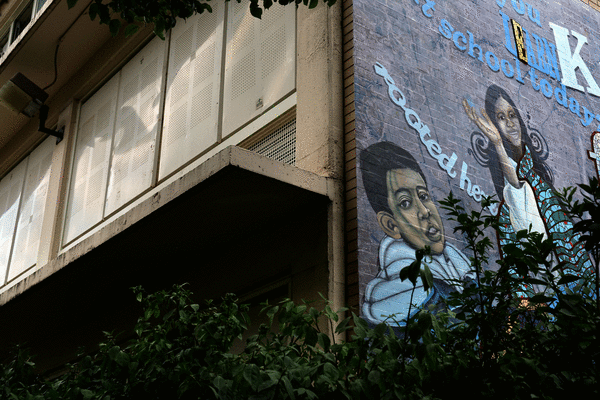
CHICAGO — In 2013, the closures of 49 public schools were referred to by then-Chicago Teachers Union chief Karen Lewis as “a scorched earth policy,” not an education plan.
When the Chicago Board of Education approved the closures that affected the city’s South and West Side neighborhoods, tears were shed, insults were exchanged, and protests were held, because the consequences of shuttering those vital community anchors were well known.
Now, a study from the University of Chicago and the Johns Hopkins Bloomberg School of Public Health illuminates a disturbing repercussion: The school closures led to increases in gun violence.
Using Chicago Police Department data covering 2010 to 2019 to understand gun violence trends before 2013, the study reveals an almost 10% increase in shootings in neighborhoods near schools left vacant since closure compared with similar communities.
Those neighborhoods also experienced increases in weapons violations and firearm-related assaults and batteries, according to the study. Gun violence “appeared to be partially mitigated,” the study said, by repurposing shuttered schools.
To reach these conclusions, the research methodology estimated how violence would have continued had the schools remained open, compared with crime data in the years after 2013.
Researchers said the analysis shows how the decision to close schools affects students and their communities far beyond access to education, according to a statement from the University of Chicago.
“They are public spaces that are used for building community by hosting events after school and providing a gathering place,” said Thomas Statchen, the study’s lead author and a medical student at the University of Chicago Pritzker School of Medicine. “When that is lost, it can impact the way neighborhoods function in ways that, as we saw in this study, could lead to increased rates of firearm violence.”
It’s nothing new to those who work in the violence prevention field.
“It was difficult because most schools were in some type of gang territory here in Chicago and when they closed the schools and forced students to go to another school — it created an uptick in the violence,” said Andre “Taqi” Thomas, the associate director of community engagement, safety and street intervention at the Inner-City Muslim Action Network, or IMAN. The Englewood native and violence prevention worker has been employed with the nonprofit since 2020.
In his role, Thomas does community outreach with the next generation. His team of three is on call to respond to shootings and the aftermath, including accompanying the accused to court and helping the formerly incarcerated find jobs when they are released.
While the city and Chicago Public Schools have attempted to sell closed school buildings for repurposing, many remain empty.
The Chicago Board of Education approved three buyers in December for the nonprofit Peace for Preston to redevelop John G. Shedd Elementary School into a community center. Arne Wendell Bontemps Elementary in West Englewood and Matthew A. Henson Elementary School in North Lawndale will be demolished for affordable housing.
Redevelopment has been a sticking point for progress, and in the interim, maintenance costs from the properties continue to mount. In January, the school board sold Louis Daniel Armstrong Elementary in Austin and Ignace Paderewski Elementary in Little Village, netting $155,500. Armstrong is slated for an athletic training center, Paderewski for affordable housing.
During Thomas’ time at IMAN, participants have dropped out of school rather than face danger by attending school in unfamiliar areas, he said. The decision to close the schools put lives at risk by forcing students to attend schools outside their communities, he said.
“Those things have to be taken into consideration over public dollars because lives should always matter,” Thomas said.
©2026 Chicago Tribune. Visit chicagotribune.com. Distributed by Tribune Content Agency, LLC.






Comments