Florida Republican claims TPS weakened Haiti police, gang fight. Reality is more complex
Published in News & Features
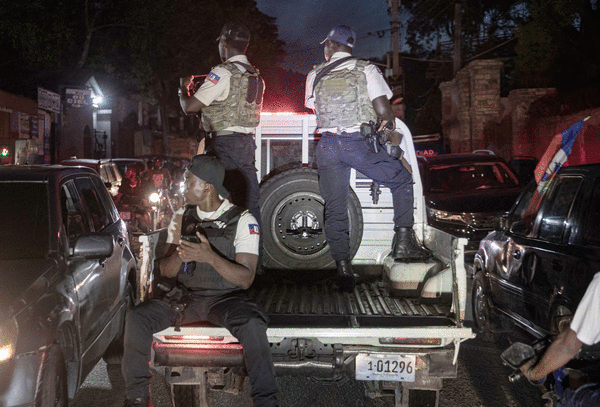
During a House Foreign Affairs Committee hearing last week on Haiti’s security crisis, Florida Republican Rep. Brian Mast repeatedly claimed that giving Haitians in the U.S. Temporary Protected Status had significantly weakened the Haiti National Police and impeded the country’s fight against terrorist gangs.
Mast, the committee’s chairman, said in opening remarks that Haitian migration to the U.S. “has allowed gangs to take control of areas like Port-au-Prince.”
Later in the hearing, Mast added that TPS had encouraged cops to leave Haiti: “My understanding of the TPS was actually that it so decimated the police force, that’s in part why they were not there to support” the international gang-fighting force led by Kenya.
“The police force had to start going to telling people they had to pick up their checks in person because so many of them came to the United States and kept collecting their direct deposits that there were no police there to do the work that they were supposed to be doing,” he said.
The Miami Herald spoke with several sources inside the Haitian national police to assess the effects of immigration to the U.S. on the force, and the country’s struggle to reclaim territory from gangs. While officials acknowledge that the police department has lost officers to migration — not just to the United States but also to Canada and other countries — the statement by Mast, who is leading a nine-member congressional delegation to visit Port-au-Prince on Monday, is not entirely correct.
A senior police official, who spoke on the condition of anonymity because he was not authorized to discuss internal matters, said the order requiring officers to report in person to get their paychecks was not related to TPS, the federal program that allows nationals of countries in turmoil to live and work legally in the United States. Instead, the directive, he said, had to do with the distribution of a new debit card.
“It was a general measure,” the official said.
The last Kenyan police forces left Haiti in March. At around that time, the police command announced that officers would receive new debit cards from Banque Nationale de Crédit, Haiti’s state-owned bank, loaded each month with a food stipend equivalent to $230. To receive the stipend, officers have to appear in person, confirming they are actively on duty. Those who fail to report are removed from the payroll.
The directive showed that some 2,000 police officers are no longer reporting for duty. Officials caution, however, that the figure doesn't mean all the no-shows had been engaged in anti-gang efforts. Nor does it fully explain the police’s inability to respond to increasingly powerful gangs, which in the last year have intensified and expanded their attacks on Haitians, public infrastructure and security forces.
In addition to controlling large swaths of the West region, which includes Port-au-Prince, gangs have expanded their reach into the Lower Artibonite, the Central Plateau and parts of the southeast. The attacks, coupled with control of key national roads, have forced nearly 1.5 million Haitians to flee their homes.
At the same congressional hearing, Col. Justin Gorkowski, the Defense Department leader of one of the teams on the new gang-fighting force that has been slowly deploying to Haiti, told lawmakers that military doctrine recommend a country needs two security personnel for every 1,000 residents during peacetime.
“So for Haiti, that’s... over 30,000 personnel,” he said.
Haiti’s security forces have never numbered 30,000, even when the country had an active military, a senior State Department official, Michael Kozak, added at the hearing.
In fact, when the United Nations Stabilization Mission in Haiti ended its 13-year deployment in October 2017, the Haitian national police had some 14,000 officers, a number that was still below recommended staffing levels.
The congressional hearing was billed as a means to understanding the daunting security challenges facing Haiti and the ability of the new Gang Suppression Force to handle them. But for many lawmakers, Democrats in particular, the more pressing issue was TPS, which may now expire on Monday, ending deportation protections for more than 300,000 Haitians living in the U.S.
On Thursday, the top U.S. diplomat in Port-au-Prince, Henry Wooster, told reporters that Haiti has “profoundly less” security personnel than is recommended for a country of its size and population. Officials estimate that only 6,000 police officers regularly report for duty.
“Where did all of those police go? I’m not sure,” Wooster said. “Some of them took TPS; some 500? I don’t really know. ..Some others stopped coming to work. I don’t know where every individual is.”
Meanwhile, he said, a far smaller number is doing “most of the fighting” against armed groups.
“The people doing the most fighting, the most brutal, door to door, house to house, room to room,” he said, “that fighting is being typically done by no more than about 400 police officers. It’s the same guys carrying most of the weight all the time.”
Those officers belong to Haiti’s specialized anti-gang units, including a new SWAT team established with U.S. support during the Biden administration and other units trained by France.
Last month, the Haiti National police marked its 31st anniversary. Many of the officers carrying out the fight against gangs are themselves homeless, displaced by the same gangs they are fighting. Some offices stationed outside the capital are forced to spend the night sleeping in subpar police stations and sleep on bare floors before heading out on operations the next day.
Meanwhile, the toll on the police force has been steep. Between June 2025 and June of this year, at least eight armed attacks were carried out by armed gangs against police infrastructure; 45 Haitian police officers were killed last year, according to a report issued by the National Human Rights Defense Network.
“Twenty-one of them fell in clashes with armed terrorist bandits,” the human rights group said.
Military solution
Haiti “is facing a military problem,” Wooster, a former soldier, emphasized in his press conference.
“It’s not a police problem,” he added. “When you think about [the Haiti National Police] and what they’re doing — they weren’t trained to be soldiers. They weren’t trained to be counterterrorism forces. They weren’t trained to be SEAL Team Six. They were trained to be police. But they’re facing a military problem. A military problem requires a military solution.”
That is why the Gang Suppression Force, which the U.S. has championed and the U.N. Security Council authorized, was designed to be larger and more robust than its predecessor, the Kenya-led Multinational Security Support mission. The Kenyan mission also came under sharp criticism during Tuesday’s hearing, by Mast and other representatives, for failing to help Haiti stem the surge of gang violence.
Unlike the Kenya-led mission, whose mandate was limited to supporting the Haiti national police, the new gang-fightng force is tasked with undertaking independent military offensive operations against gangs using soldiers, not police.
“Their mission is neutralize, isolate and deter,” Wooster said.
The force could buy Haiti time and help push back the gangs, but lasting progress will depend on Haitian institutions, said Wooster, who is preparing to leave Haiti to serve as U.S. ambassador to Kenya.
“Haitian security forces must regain capacity to defend their homeland and enforce the rule of law,” he said.
As part of that effort, the United States is supporting a recruitment and training initiative with the goal of training and graduating 4,000 Haitian police officers through an accelerated program.
“We are more than halfway there today,” Wooster said. He added that Congress had recently lifted “decades of restrictions” on cooperation with Haiti’s armed forces and that the Haitian government has made rebuilding the military a priority through new recruiting efforts.
©2026 Miami Herald. Visit at miamiherald.com. Distributed by Tribune Content Agency, LLC.






Comments