A 72-year-old criticizes Florida's wildlife agency. They searched his personal data 34 times
Published in News & Features
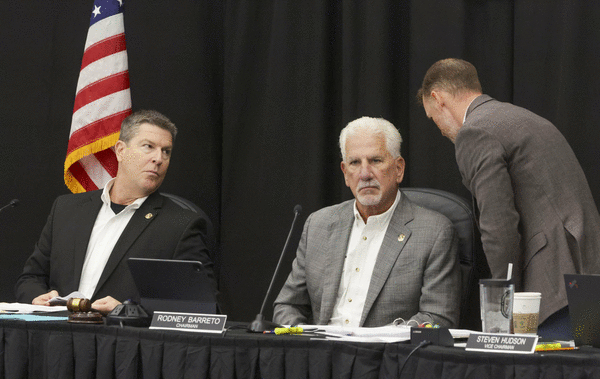


TAMPA, Fla. — Like he had a dozen times before, Jim Watt stood behind the lectern and addressed Florida’s wildlife commission.
“Good day, commissioners,” he began.
“As you know, my name is Jim Watt, and this is my 13th time in front of you, pleading with you to stop killing our wildlife and destroying their habitats with dangerous pesticides,” Watt told the governor-appointed board.
The concerns raised by the retired turtle farmer during his three-minute speech were the same as always: The state is spraying too many harmful chemicals into waterways in the name of curbing invasive plants.
“In spite of all my pleading over the years, nothing changes,” Watt told the Florida Fish and Wildlife Conservation Commission at its Oct. 5, 2023, meeting in Jensen Beach.
What Watt didn’t know at the time was, just 14 days earlier, an agency staffer had pulled his personal records from a state database used by police when investigating suspects.
The reason given for the search? “Criminal investigation.”
It wasn’t the first time the wildlife agency accessed Watt’s personal data: Staff had pulled his vehicle information three months earlier.
It wouldn’t be the last time, either. Since that October 2023 commission meeting, records show, the Florida Fish and Wildlife Conservation Commission has pulled Watt’s data 30 more times.
The 72-year old isn’t alone.
He is one of more than 20 people, mostly environmental activists and the agency’s loudest critics, whose information has been pulled from the Driver and Vehicle Information Database in recent years under the label of a criminal investigation.
That’s according to public records gathered by a coalition of affected activists and shared with the Tampa Bay Times, which has independently verified Watt’s records with the Florida Department of Highway Safety & Motor Vehicles. The Miami Herald and Orlando Sentinel first reported the searches July 18.
Law enforcement uses the database to retrieve driver information, but the system also includes signatures, Social Security numbers and medical data. The information is sensitive, so public access is regulated by the federal Driver Privacy Protection Act.
Watt isn’t under criminal investigation, Shannon Knowles, a spokesperson for the wildlife agency, confirmed to the Tampa Bay Times. Neither are other activists who had their information accessed, she has told other media outlets. The Times has submitted records requests to determine whether past investigations occurred but has yet to receive a response.
Watt spends his retirement poring over state records about chemical spraying. He then brings his findings into the public square. It’s basically his full-time job: “I’m tenacious — and I know it," he said in an interview.
“I am a real thorn in their ass, sure. But I have never, ever threatened anybody.”
The searches have raised questions about free speech, a potential abuse of law enforcement tools and where the line exists between investigating credible threats and surveilling outspoken environmental critics.
State staffers appear to have pulled Watt’s data more than any other environmental activist in the records: 34 times between June 2023 and February 2025. That’s according to a running tally from the group of activists who were searched, with inquiries into other critics including Chuck O’Neal, a founder of Speak Up Wekiva, and Ryan Worthington, host of the The Florida Excursionist conservation podcast.
The records detail a sustained pattern of inquiries into Watt. In February 2024, for example, a wildlife staff crime analyst sought information about his vehicles. A year later, a separate staffer sought his addresses. One day, in January 2025, staff accessed 16 records.
The records show who searched Watt’s records, when and why, with a field for the agency to track the purpose of every inquiry. All of the searches list “criminal investigation” as a reason.
In a statement, the agency defended its use of the state database to pull information on outspoken activists, saying the inquiries were “conducted for public safety purposes” for recurring commission meetings.
“Assessing credible threats to the people who attend our meetings and work in our facilities is a legitimate and lawful function of law enforcement, and we take every threat seriously,” the agency said in a statement separate from Knowles’ comments to the Times.
While Watt is a regular attendee of commission meetings, others who had their records pulled are not.
Wildlife staff accessed Brent Fannin’s records seven times via the database, he said. The documentary filmmaker, whose 2024 film scrutinized the agency’s handling of gopher tortoise permits for developers, said he’s never been to a commission meeting.
“I think it’s clear that the unchecked power that (the agency) has is being abused by the powerful people that run it,” Fannin said.
Months after he helped write a legislative proposal that would have reformed who can be appointed to the wildlife board, Fannin said he got an anonymous email that he was under criminal investigation. That led him down a path to confirming that he, along with more than 20 others so far, had their records accessed.
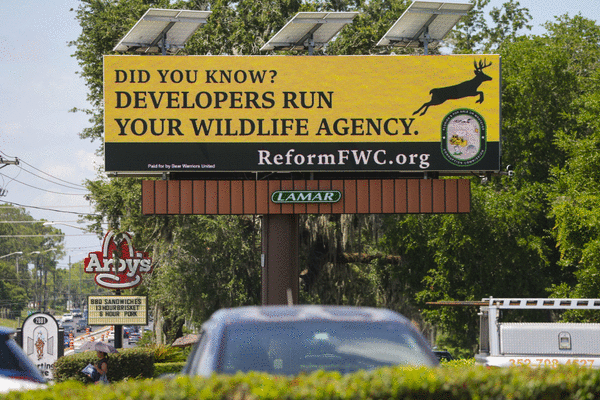
“What is supposed to be a conservation organization is being weaponized to surveil any opponents of development interests,” Fannin said.
In response to media reports and heightened public scrutiny, the wildlife agency last week released a redacted document with a sampling of 17 threats made against it on social media. The Times has requested a copy of the document with the names visible but has not yet received one.
The agency has justified its data searches in statements to reporters by saying its employees have been doxed and that a wildlife commissioner’s business was “targeted” via a protest and negative reviews.
The wildlife agency has faced intense public scrutiny over spraying aquatic herbicides in the past. In July 2023, it stopped publicly posting its schedule of where and when Florida’s waterways would be sprayed.
Officials made the decision over “ongoing threats and harassment” to staff and herbicide contractors, Knowles said.
One of the example comments the agency provided to the Times is about using the chemicals in Florida waters: “If you hang the people spraying, they will stop,” the person wrote. It’s not clear who made the comment, or on what platform.
Watt said he didn’t write any of the threats the agency provided and has “never remotely threatened anybody.”
“I can’t control what people say on Facebook,” he said. “I’m very outspoken, but I don’t want to hurt anybody.”
The Times ran a criminal background check on Watt and found a misdemeanor vagrancy arrest from 1971, when he was 17 in Key West. He had a misdemeanor arrest for hitchhiking four days later.
“I didn’t have a vehicle or gas to put in it. I had hair down to my butt. I did it all for the adventure,” Watt said.
When asked whether the agency believed Watt was responsible for the threat — or if the agency could provide examples of violent threats he made that would prompt a criminal investigation — Knowles said: “Ongoing threats and harassment are not specific to one individual.”
At least one Democratic lawmaker has pushed for an investigation.
In a letter to agency head Col. Roger Young on Wednesday, state Sen. Carlos Guillermo Smith, an Orlando Democrat, asked the commission to clarify its use of the database. Calling it “baseless surveillance of environmental activists,” Smith said he filed a complaint with the Office of Inspector General.
Activists who have had their information accessed are also planning to sue.
Katrina Shadix, executive director of the nonprofit Bear Warriors United, had her personal information accessed at least 17 times in the driver database, according to the group’s analysis. Shadix said they hope to file a suit against the agency within a week.
“If they’re threatened by bear-loving tree huggers, they need to get out of their line of work and go somewhere they feel safer,” Shadix said. “We love trees and animals.”
_____
©2026 Tampa Bay Times. Visit tampabay.com. Distributed by Tribune Content Agency, LLC.






Comments