The Kid Whisperer: How bad child-raising advice has come to dominate our culture
Published in Lifestyles
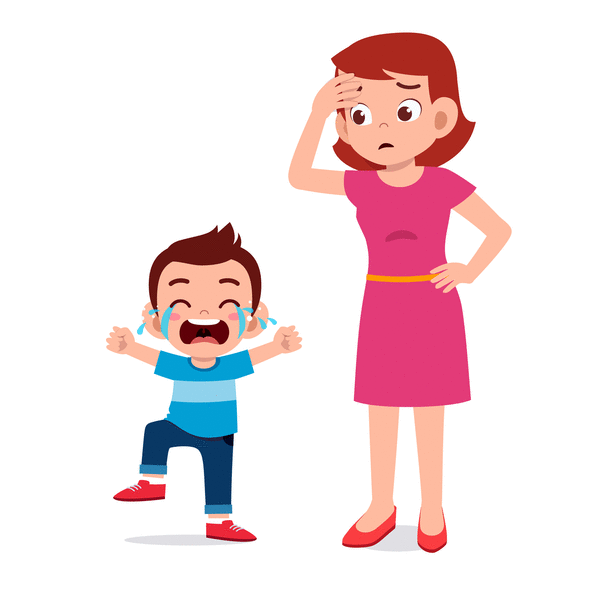
We are living through The Era of Collective Parental Psychosis: a time whereby we have forsaken the Collective Parental Wisdom amassed by parents throughout all of human evolution to instead favor irrational and nonsensical ideas about raising kids.
This collective wisdom had been spread in the simplest, most natural and most effective way possible: We humans generally raised our kids the way our parents raised us by either instinctually mimicking our parents or by actually listening to them about how to raise their grandchildren. While child-raising methods of individual parents may have been far from perfect, the effectiveness of the collective wisdom of all parents in history is hard to deny. We accepted that kids should be required to work hard, to be resilient, to be kind and to respect their elders.
The Era of Collective Parental Wisdom that began to develop at the dawn of humanity started to give way to The Era of Collective Parental Psychosis in the 1950s and 1960s during the rise of the “parenting expert." These people wrote best-sellers that parents consumed en masse. These books either explicitly taught or were misinterpreted as teaching lessons that ended up negatively affecting our families, our schools, our communities and our country. Now, as social media has come to dominate our social landscape, these terrible ideas have become omnipresent in the minds of modern parents:
1. Never say “no” to a kid because it will damage their self-esteem.
2. If a kid uses negative behaviors, it doesn’t mean that they just need to learn to behave better. Rather, it means that they need to receive talk therapy by a parent or professional, and if that doesn’t stop the behavior, the kid probably has some sort of pathology or mental illness.
3. Kids are fragile, so you must protect them in all ways, at all costs.
Much of the reason these terrible ideas spread is that parents love to let the world know that they are more sensitive and nicer than others during discussions at cocktail parties, at the park or at “parenting” book club meetings. More recently, social media has made these destructive ideas go viral, and because the algorithms spread ideas that make people feel instead of asking them to think, the ideas have become worse and worse, and more and more destructive. The more a post makes people feel scared, or angry, or self-righteous, the more it spreads.
Conversely, very few parents want to get on social media and talk about how they set limits with their kid, or how they held them accountable, or, God forbid, how their kid was acting like a jerk at the mall, that it made the parent furious, and that it is not OK. If they do, they leave themselves open to someone commenting about how that common-sense parent is not nice or sensitive enough. Furthermore, very few people want to like, comment positively or share something that is not sufficiently nice or sensitive, for fear that they will be cast out and labeled a monster.
This creates a nearly totalitarian shroud over the conversations related to raising children online and offline: You dare not speak of limits, consequences, or of what it’s really like to be a parent, lest you be cast out as not nice, or not sensitive. While this exists in real life within relatively small groups of people, it can exist online among an angry hoard of literally hundreds of thousands of people.
This is why, on social media, nice and sensitive and horribly damaging advice goes viral, while posting something that may be helpful but less nice can be considered, and feel like, a mortal sin. This is why social media is where common sense goes to die.
We need to have the courage to return to what wise human beings have been saying for centuries about real truths that have been discovered by inquiry and experience gleaned from centuries of human experience: It is true that kids should work hard, be resilient, be kind, and respect their elders. These truths are not subjective, they’re just true. It would serve us well to start reading and listening again, learning real truths about how to raise our kids.
____
©2026 Tribune Content Agency, LLC.



















Comments