
2026 Toyota Tacoma
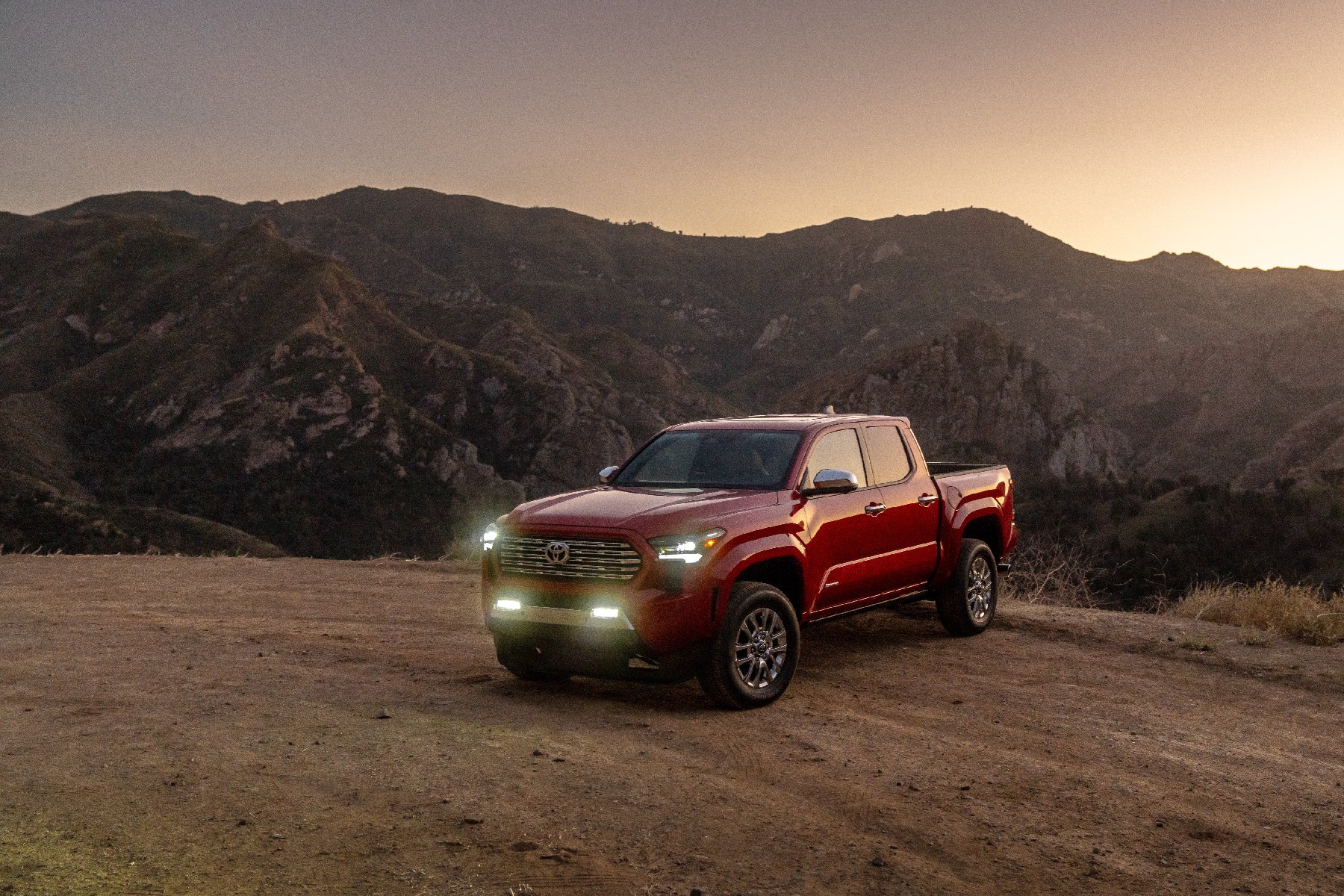
There are five midsize pickups available right now, but only one even offers a manual transmission -- something that was once usually standard in pickups. The Ford Ranger, Nissan Frontier, Chevy Colorado and its GMC sibling the Canyon are all automatic only.
If you still like to row your own, there's only one choice: the Toyota Tacoma.
What It Is
The Tacoma is a midsize truck available in two-door extended cab (called XtraCab) and four-door Double Cab configurations, with the two-door/extended cab version having a 6-foot bed while the four-door Double Cab comes with either a 5-foot bed or (optionally) the longer 6-foot bed. All trims come with a 2.4-liter four-cylinder engine in three different output levels (one of them hybrid-augmented).
Prices start at $32,445 for the SR extended cab with two-wheel drive; four-wheel drive can be added as a standalone option. So equipped, the MSRP goes up to $35,645. The SR comes standard with the 228-horsepower version of the 2.4-liter four, an eight-speed automatic, 17-inch wheels and LED headlights.
The SR5 gets a stronger (278-horsepower) version of the 2.4-liter four, along with an upgraded rear suspension (coil springs instead of the leaf springs that come with the SR) as well as a bed rail/moveable cleat tie-down system for the bed. The 2WD version lists for $36,535; with 4WD the MSRP increases to $39,735.
You can also get the XtraCab/6-foot bed version of the Taco in TRD PreRunner form ($39,035). This one comes standard with 4WD and the more powerful version of the 2.4-liter engine, along with a lifted suspension, locking rear differential, skid plates, trim-specific 17-inch wheels, a digital main instrument cluster and leather trim.
The Double Cab is available in more trims -- as well as the base SR and SR5 trims, with prices for those beginning at $34,105 for the former and $37,605 for the latter. In addition, there is a TRD Sport ($40,315) eligible for the six-speed manual transmission -- paired with the 278-horsepower engine. It starts at $40,315 with 2WD (with the automatic) and the 5-foot bed or $40,815 with the 6-foot bed. If you want the manual six-speed, it lists for $42,715 and you get the shorter, 5-foot bed. The six-speed isn't available with the 6-foot bed -- or with 2WD.
There are also TRD OffRoad ($40,315), Limited ($53,470), TrailRunner ($63,659) and TRD Pro ($64,650) versions of the Double Cab.
What's New for 2026
The TrailHunter trim is new. It comes standard with the strongest (hybrid-augmented) version of the 2.4-liter engine (326 horsepower) and additional off-road upgrades, including Old Man Emu shocks. rock rails and additional underbody protection, 18-inch bronze anodized wheels and 33-inch knobby tires, plus an ARB bed utility bar with removable panels.
What's Good
-- Standard engine is much stronger than the previously standard engine.
-- You can still get a manual transmission.
-- You can still get a two-door (and a 6-foot bed).
What's Not So Good
-- You can't get the manual in the less expensive (2WD) trims or with a 6-foot bed.
-- Standard price has gone up by about $3,000 versus the previous generation Taco.
-- No more V6 engine.
Under the Hood
The previous-generation Tacoma was available with both a four-cylinder engine and a V6 engine, and neither of these engines was turbocharged (or hybrid-augmented). The formerly standard 2.7-liter four wasn't very powerful -- it made just 159 horsepower -- but it was a durable workhorse, and because it didn't have a turbo, a Tacoma equipped with one cost less to buy and also less to keep as the years and miles rolled by -- because there was no turbo or intercooler to go bad and need replacing. Also, the engine was under less pressure -- literally -- and that usually correlates with longer life. The non-turbocharged four-cylinder engines that used to be standard in the Tacoma and all its rivals were known to be almost unkillable, which made up for their being on the underpowered side.
The Taco's previously standard 3.5-liter V6 was certainly adequately powerful (278 horsepower), and it was revered for being at least as durable as the 2.7-liter four.
Well, they're both gone now -- in favor of a smaller (but much stronger) 2.4-liter four that is turbocharged and also (in its strongest variant) hybrid-augmented.
The standard version of the 2.4-liter turbo'd four makes 228 horsepower -- 69 more than the old 2.7-liter four -- and also a lot more torque (243 foot-pounds at 1,600 RPM versus 180 foot-pounds at 3,600 RPM). Gas mileage is slightly better than it was, in spite of the power uptick: 20 mpg city, 26 mpg highway versus 20 mpg city, 23 mpg highway previously. However, the Taco's maximum tow rating with this engine is still just 3,500 pounds, the same as it was for the previous generation with the much less stout 2.7-liter four. That's odd, because the new four probably can competently pull more than just 3,500 pounds (while the old 2.7-liter four was definitely close to the limits of what it could pull with a 3,500-pound trailer hitched to the rear bumper).
More power -- and towing capacity -- is available if you opt for the 278-horsepower version of the 2.4-liter four. Note that this engine's rated output exactly matches that of the old 3.5-liter V6. So also the max-rated towing capacity (6,400 pounds). Fuel economy is also about the same: 20 mpg city, 24 mpg highway versus 19 mpg city, 24 mpg highway with the old V6. It's pretty obvious Toyota tailored the up-rated 2.4-liter four to mirror the output and capabilities of the old 3.5-liter V6 so that Taco buyers who want the output/capabilities of a V6 will be OK with a turbo'd four.
Another change is what's bolted to the four. Both iterations come standard with an eight-speed automatic now; previously a six-speed automatic was used. You can still get a six-speed manual but only in higher-trim Double Cabs with 4WD. Still, the fact that you can get it gives the Taco a unique appeal over its automatic-only Ford Ranger, Chevy Colorado, GMC Canyon and Nissan Frontier rivals. By the way, the only of these four competitors that still even offers a V6 is the Frontier, which actually comes standard with one.
There's one more option to consider -- if you buy a Double Cab Taco. These are available with hybrid-augmented drivetrain that Toyota calls i-Force Max. It pairs the turbo'd 2.4-liter engine with a battery pack and an electric motor to provide an increase in on-demand power to 326 horsepower (and 465 foot-pounds of torque) while also reducing fuel consumption by cycling the gas engine off as often as possible, such as when the Taco's decelerating/coasting or not moving. When the engine is off, the battery powers accessories. The hybrid's mileage -- 22 mpg city, 24 mpg highway -- is slightly better than that of a Taco with the nonhybrid, 278-horsepower iteration of the 2.4-liter four, but because of the additional weight, the max tow rating goes down a bit to 6,000 pounds. Also, the hybrid drivetrain is only available with 4WD and with the automatic transmission.
On the Road
When the Taco was a small (compact) and inexpensive truck, it drove like one. It wasn't bad. But it was bouncy and light-feeling. You sat close to whoever was riding shotgun too. That's what you got for the money. The current Taco has the beefy, solid feel of a full-size truck (by early 2000s standards). It almost is full-size in every way except width -- and even that's close.
The thing is, early 2000s full-size trucks were a nice size -- and so is the current Taco. It's big enough to not feel small but not so big it feels huge -- as current full-size trucks are. The Taco can be driven comfortably between the cement abutments at a bank drive-through, and you're not so high up off the ground that you can't reach down to get your hands on the tube that goes through the vacuum chute to the teller inside. It doesn't hog up so much space to either side of the cars parked beside you at the supermarket that you can't open the doors all the way to get out/in (at least, not without denting the sides of the car parked next to you).
In a word, it is manageable.
This is the appeal of the thing. It's a real truck -- not a toy truck. But it's not a monster truck, either.
Or a slow truck. Even with the standard (228-horsepower) version of the 2.4-liter turbo four, the current Taco can get to 60 mph in about eight seconds. The previous-generation Taco with the 2.7-liter four (159 horsepower) needed about 11 seconds. That's not just a big difference; it's a big real-world difference. With the stronger (278-horsepower) version of the 2.4-liter four, the 0-60 mph time goes down to about seven seconds. The hybrid makes the run in about the same time (the extra power is offset by the extra weight).
It's the manual that makes all the difference, though -- since the Taco is the last truck in the segment that offers this option. Quantifying this is not as easy as noting 0-60 mph times. In fact, the 0-60 mph times quoted for the manual-equipped truck are a few tenths slower than with the eight-speed automatic, which shifts smartly, without ever missing a shift, which happens sometimes when you shift yourself. That said, shifting for yourself is just fun -- and that kind of fun is only available in the Taco.
At the Curb
It's not an exaggeration to compare the current Taco to the full-size trucks of the early 2000s. The two-door SR5 with the short (5-foot) bed is 213 inches long, and the Double Cab with the 6-foot bed is 226.2 inches long. For reference, back in 2001, a full-size (half-ton) Tundra SR5 was 217.5 inches long. It was also 70.7 inches tall and 75.2 inches wide. The 2026 "midsize" Taco stands 73.8 inches tall and is 76.9 inches wide. The lifted TRD PRO versions are taller.
Still, it's manageable. A step ladder or old bucket to stand on is not needed to get at whatever you put in the bed, and you don't need running boards to climb up into the cab.
Outside, it looks rugged -- not steroidal. Current full-size trucks look juiced and angry. The Taco's for the person who doesn't want that look or need the over-the-top-ness of current full-size trucks.
The Taco's bed is made of a lightweight composite material that doesn't dent. But it does crack.
If you spring for the available JBL premium audio system, you'll get a neat feature: The center speaker mounted on top of the dashboard can be removed (just push the button) and used as a portable Bluetooth speaker.
The Rest
The one thing the new Taco hasn't got is an affordable price tag. Even the base SR with just 4WD is already south of $35,000; the tested Double Cab/4WD model with the TRD off-road upgrades was south of $55,000. Back in 2001, a full-size Tundra listed for $20,895. Yes, really. And -- yes -- inflation. But still. There is no denying that trucks -- like everything else -- have gotten a lot more expensive. Yes, they're a lot nicer. But what does that matter if you can't afford them?
The Bottom Line
The new Taco is a very different truck than previous Tacos, which has its good and its bad points. Mostly, it comes down to whether you can afford all the good points.
========
Eric's latest book, "Doomed: Good Cars Gone Wrong!" will be available soon. To find out more about Eric and read his past columns, please visit the Creators Syndicate webpage at www.creators.com.
Copyright 2026 Creators Syndicate, Inc.






Comments