NASA Langley Research Center opens first wind tunnel in more than 40 years
Published in Science & Technology News
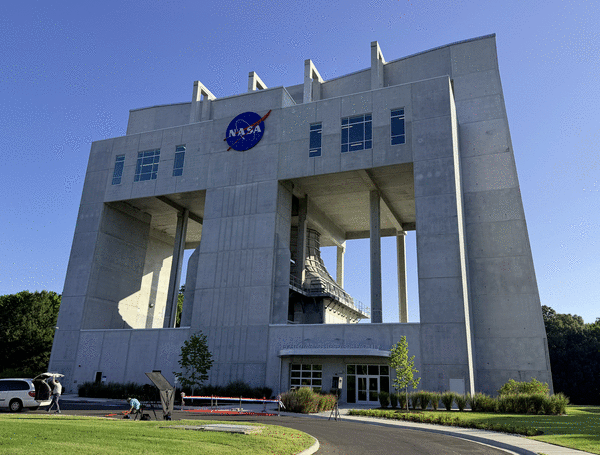
HAMPTON, Va. — NASA officials and state leadership cut the ribbon Friday on the agency’s first new wind tunnel in more than 40 years as the agency undergoes a wave of consolidation.
The Flight Dynamics Research Facility at Langley Research Center is a 25,000-square-foot facility that aims to play a major role in providing research for flight vehicles and drones, as well as support the development of technology for missions like returning from the moon and Mars, exploration of Venus and Saturn’s moon Titan.
One of the building’s main features is a 20-foot-wide, 24-foot-tall vertical wind tunnel that operates similar to an indoor skydiving park, according to facility manager Corey Diebler. The facility will be used to advance space exploration and aeronautics through free flight and oscillation testing, along with other simulations.
As the tunnel hummed into operation, NASA Administrator Jared Isaacman poured water into the device and watched it float as a nearby monitor clocked nearly 200 revolutions per minute. Isaacman highlighted Langley’s wind tunnels’ contributions to scientific advancement over the last century and said this project marks the beginning of a new age where that research can be pushed even further.
“It’s not lost on anyone the importance of a facility such as this,” Isaacman said. “This is a great way that we can continue to learn very quickly and advance the next generation of aircraft.”
The U.S. General Services Administration awarded the design-build construction contract for the facility to developer BL Harbert in 2021, and construction began in 2022. The total cost of the facility was roughly $57 million.
That price tag awarded Langley a tunnel 6 to 8 feet wider than most others in the world, more than double the wind speed and five times the forced power of existing wind tunnels, according to construction project manager Ryan Smith.
The larger capacity means some NASA projects will move to Langley, including a device headed for Venus and research on the X-59 supersonic aircraft. Another one of those projects is RAVEN, a 1,000-pound unmanned aircraft.
The RAVEN device has propellers that work like a helicopter that turn midflight to operate like a plane. In order to do that safely, research aerospace engineer Ben Simmons said he needs larger facilities like this one to figure out how to make that transition in the air.
“We know how to fly it like a helicopter. We know how to fly it like a forward-flight vehicle. It’s that transition that I see as one of the biggest challenges,” Simmons said. “That’s what we’ve been studying in this wind tunnel.”
There’s a catch, though.
The new facility will replace two of Langley’s other wind tunnels: the 20-foot vertical spin tunnel, built in 1939, and 12-foot low-speed tunnel, built in 1941. Both tunnels were decommissioned last year and will be demolished, after which the land will revert to the Air Force base. There is no timeline for the demolitions, according to Langley spokesperson Brittny McGraw.
Isaacman said the move is “the right direction” for the agency to prioritize resources going toward strictly necessary services in order for NASA to fulfill its mission.
“If we continue to invest our resources maintaining a lot of our historic facilities that have less current or anticipated demand, it will come directly at the expense of the next generation capabilities that are going to be essential to meet the mission of today, and also all that we imagine going forward,” Isaacman said.
Langley Research Center Director Trina Dyal echoed Isaacman’s stance and said closing older facilities is necessary to be good stewards of Langley’s funding.
“In order of supply and demand, this absolutely has a demand, and now we’re providing the supply,” Dyal said.
Langley was home to seven of NASA’s 12 wind tunnels. NASA’s predecessor, the National Advisory Committee for Aeronautics, built a 5-foot vertical wind tunnel in 1929 and was the agency’s fifth such facility. Langley continued researching and evolving that aeronautics work over the next several decades.
The Trump administration in 2025 proposed closing five unspecified wind tunnels and gutting Langley’s workforce. That budget proposal also attempted to cut NASA’s overall budget by roughly a quarter, but Congress largely restored the agency’s funding in January.
U.S. Sen. Mark Warner, who attended Friday’s event, applauded Isaacman’s leadership. But he said as NASA employees have left or been laid off, the loss of institutional knowledge needs to be rebuilt and preserved.
“It’s been rough the last year plus for federal employees, and we lost too many folks at NASA, some of the best colleagues,” Warner said. “The fact that we are now rebuilding that, bringing more people in is, I think, an enormous benefit.”
Isaacman said historic facilities like Langley’s two now-decommissioned wind tunnels don’t add enough value to receive continued maintenance, and that approach is something the agency needs to see more of to help reduce bloat.
“This is a model that we need to be replicating across a lot of the NASA centers right now,” Isaacman said. “What is no longer required for today, where we have little demand, free up those resources to invest in critical capabilities for the future.”
_____
©2026 The Virginian-Pilot. Visit at pilotonline.com. Distributed by Tribune Content Agency, LLC.






Comments