Commentary: Why history needs no training wheels
Published in Op Eds
Language is a living organism, constantly adapting and shifting to reflect the society that wields it. Historically, this evolution has been characterized by expansion, specifically the continuous absorption of new concepts, cultural exchanges, and technological advancements that broaden our collective vocabulary.
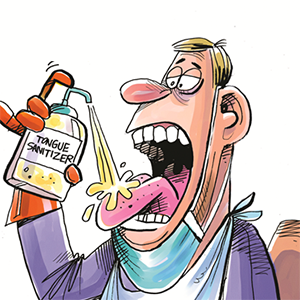
Yet, observing the current trajectory of our public discourse, one could easily argue that this evolution has taken a peculiar turn. Today, our language is defined less by addition and increasingly by subtraction. Year by year, the perimeter of acceptable speech grows tighter, monitored by a cultural consensus that is as punitive as it is unpredictable. As our language supposedly evolves, it appears we are allowed to say less.
This phenomenon of retroactive sanitization becomes glaringly obvious when we look to the past. Consider J. Mark Powell’s masterful compilation, “Witness to War: The Story of the Civil War Told By Those Who Lived It.”
Powell achieves something remarkable simply by stepping out of the way of his subjects. By curating more than 500 previously unpublished letters from the 1860s and presenting them in their exact, original form, he delivers a profound and unfiltered account of history.
There are no “trigger-warning-translations” inserted to protect the modern reader’s delicate sensibilities. The words on those pages are visceral, honest and entirely raw.
Reading them, one realizes that neutering these historical accounts for the sake of political correctness would strip away the genuine emotion and lived reality of the era. Preserving the exact vernacular of the time is the highest form of respect an author can pay to the past. It offers history without the training wheels.
What happens when we apply this rigorous standard of authenticity to our present? We have already witnessed dramatic linguistic shifts in our own lifetimes. Words that were once commonplace, everyday descriptors, such as the “n” word, or the use of “Indian” to reference Native Americans, are now understood through a highly critical lens and met with severe, often justified, judgment.
Society has collectively decided to leave certain terms behind. The machinery of sanitization rarely stops at universally agreed-upon slurs. The cultural filter is perpetually hungry for new material to clean up, often catching nuanced expression in its net.
This raises a fascinating, if somewhat unsettling, question. What words and phrases that we use casually today will be fiercely banned tomorrow? If a historian curates our emails and text messages in 2126, what everyday idioms will require a severe content warning?
It is not difficult to imagine a future where basic descriptors of biological reality, traditional familial terms, or even phrases that imply subjective merit or adversity are deemed too “unsafe” for polite company. We may find that colloquialisms addressing the content of one's character, or acknowledging the varied and complex experiences of an immigrant, are flattened out and erased by a rigid, one-size-fits-all lexicon dictated by future moral arbiters.
Paradoxically, while we hyper-police benign vocabulary, society often shrugs with profound apathy at overtly hostile messaging. We scrutinize the micro-implications of everyday pronouns, yet barely bat an eye at the casual, trendy misandry of a “#killallmen” hashtag or a department store aggressively marketing a pre-Valentine’s Day “Dump Him” sweatshirt. The rules of what is acceptable are wildly inconsistent, driven more by fleeting cultural tides and performative outrage than by any grounded moral framework.
The ultimate danger of this incredibly shrinking dictionary is not just the loss of colorful expression; it is the slow, quiet death of constructive disagreement and viewpoint diversity. Genuine open inquiry relies entirely on the ability to articulate complex, controversial and offensive ideas without the paralyzing fear of immediate excommunication. When we are forced to navigate a minefield of ever-shifting linguistic taboos, we stop having honest conversations. We retreat into safe, pre-approved platitudes. Academic freedom, robust debate and critical thinking cannot survive in an environment where the permissible vocabulary is constantly being amputated.
If the men and women of the 1860s whose letters fill the pages of “Witness to War” were alive today, they would be immensely proud that their true, unfiltered selves were not erased by modern sensitivities. We owe it to ourselves, and to the historians of tomorrow, to leave behind an equally authentic record of who we are.
We must resist the urge to constantly sanitize our discourse. A society that restricts its words inevitably restricts its thoughts. It is time to take the training wheels off our conversations, embrace the discomfort of open inquiry, and trust one another enough to speak the unvarnished truth.
____
ABOUT THE WRITER
Nafees Alam is a professor in social work at Boise (Idaho) State University. He wrote this for InsideSources.com.
_____
©2026 Tribune Content Agency, LLC.




































Comments