Commentary: Howard Zinn spoke to this moment, even decades ago
Published in Op Eds
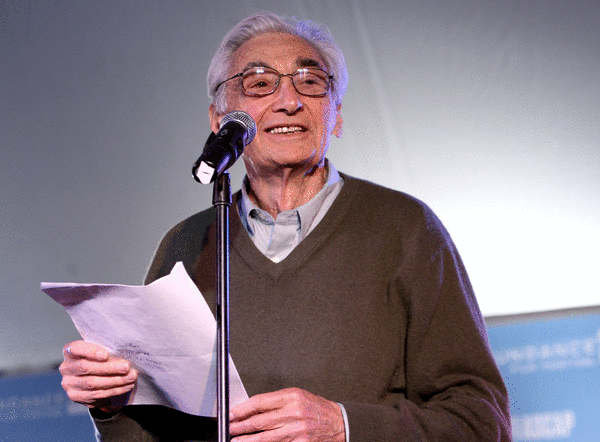
Not many historians have seen their work referenced on “The Simpsons” and “The Sopranos.” Not many historians have been condemned by name by a president on the White House lawn for the “crime” of researching and writing about this nation’s history. And not many historians have taught countless people that this country’s past looks quite different depending upon the perspective of those doing the telling. This is Howard Zinn, who shaped Americans’ understanding of themselves through seven decades of activism and whose insights should continue to color how we understand the news of the day.
Zinn is both perhaps the most banned historian in U.S. history and the author of arguably the most enduring U.S. history text, the 46-year-old and still best-selling “A People’s History of the United States.” He had died a decade earlier when President Donald Trump — amid the worst of the COVID-19 pandemic — held Zinn responsible for “left-wing rioting and mayhem” and “propaganda tracts … that try to make students ashamed of their own history.”
At the barest-bones level, detractors attack Zinn for the same reason teachers, students and readers celebrate him: because his work inspires people to think critically, fight back and make their own history. For the authoritarian, the thought of people being inspired in such a manner is chilling. It also contradicts their politically useful belief that history only happens at the behest of “great men.” Those who’ve read Zinn — and some of the generations of historians inspired by him — recognize this to be the greatest lie of all. As he wrote: “The good things that have been done, the reforms ... all of that was not done by government edict. ... It was all done by citizens’ movements. ... What really matters is what are people doing, and what are people saying, what are people demanding.”
And yet the last 10 years have been difficult for those influenced by Zinn. We saw mass protests across the globe in the 2010s, but some of these “citizens’ movements” drew violent backlash. In the 2020s we have seen Trump returning to power at home and right-wing authoritarianism on the rise internationally. This has caused people to ask me often, with a mood ranging from wry melancholy to despair, what Howard Zinn himself would say about our current state of affairs. People wonder what this radical optimist could possibly feel positive about in these increasingly dark times.
It’s a dangerous game to speak for those not here to speak for themselves, but Zinn said and did enough in his life to at least provide a road map to what his observations could be. After all, he was an engaged activist for more than 70 years and he left behind a trough of speeches that speak to this very predicament of whether we should lose hope when movements fail.
If Zinn were here today, he would first ask questions. He’d want to know how politics became so dark; why young people — whom he always saw as a motor of history — could be so angry at the world but also so despondent about whether change could happen, about whether another world is even possible. Zinn would not ask these questions with anguish. Born in 1922, he had experienced too much in his life — from the Great Depression to FBI harassment — to lack perspective in reactionary times. Zinn instead would want a set of facts he could analyze and understand. He would also be pointing to times in history that were darkest before dawn.
Zinn once said: “An optimist isn’t necessarily a blithe, slightly sappy whistler in the dark of our time. To be hopeful in bad times is not just foolishly romantic. It is based on the fact that human history is a history not only of cruelty but also of compassion, sacrifice, courage, kindness. What we choose to emphasize in this complex history will determine our lives. If we see only the worst, it destroys our capacity to do something.”
I emphasize “only” to point out that Zinn is not saying to ignore the worst or pretend it is not happening. Just to not let despair — at the expense of evidence in front of our eyes — guide our politics or our frame of mind. History proves that when there are green shoots pushing out of the concrete, then — to paraphrase Tupac Shakur — those of us who want change need to tend to them, not ignore or even stomp these glints of hope because they aren’t yet what we want them to be.
We need hope and truth-tellers more than ever because this country at 250 is being smothered: suffocating under an avalanche of disinformation and “alternative facts.” Fighting for the truth — however inconvenient — means telling the stories of the deliberately unheard. That was the life’s work of Howard Zinn. And we need it more than ever.
____
Dave Zirin is the author of 12 books, including the forthcoming “ The People’s Historian: The Outsized Life of Howard Zinn.”
©2026 Los Angeles Times. Visit at latimes.com. Distributed by Tribune Content Agency, LLC.



















Comments