John M. Crisp: We've chosen the wrong side in the Middle East
Published in Op Eds
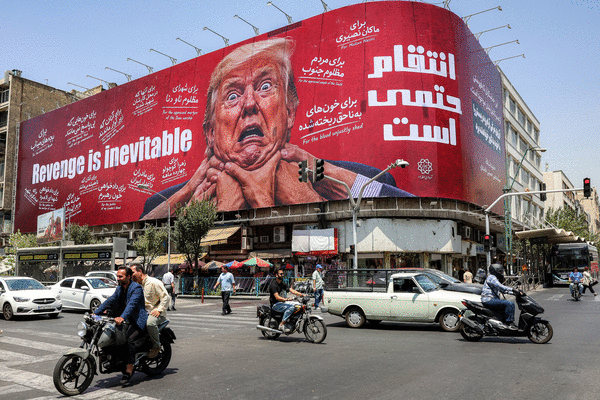
This column evokes the idiom “The horse has already left the barn.” But, as one respected journalist (my brother David) has noted, if the horse has left the barn, the thing to do is to saddle up another horse, corral the first horse and return her to the barn.
Unfortunately, the horse I’m referring to, Iran, is long gone. We’ve chosen to ride Saudi Arabia, instead.
In fact, President Donald Trump has chosen between the two countries in the most emphatic way: In order to prevent it from possessing nuclear weapons—among other vague objectives—he is making war on one country, while last week providing the other country with a feasible path to nuclear weapons.
At least Trump proposed the possibility: On July 22, Trump announced a deal that would permit U.S. firms to develop nuclear capacity in Saudi Arabia, ostensibly for peaceful purposes. But some nonproliferation experts have raised concerns about how effectively the arrangement limits Saudi Arabia’s ability to enrich to weapons-grade levels.
The deal also does not provide for the customary involvement of the International Atomic Energy Agency, whose protocols include inspections and verification of compliance.
The next day, however, Trump torpedoed the deal by making it dependent on Saudi Arabia’s acceptance of the Abraham Accords and requiring the kingdom to normalize relations with Israel. This is highly unlikely.
In short, similar to the Memorandum of Understanding with Iran, the “deal” was announced before all the details had been worked out.
Some dealmaker.
But why are we choosing Saudi Arabia over Iran, anyway?
After all, Saudi Arabia is a kingdom, not a republic. It’s currently ruled by king-in-waiting Crown Prince Mohammed bin Salman, who is clearly a murderer because of his involvement in the death and dismemberment of the journalist Jamal Khashoggi in 2018.
The authoritarian Crown Prince rules with a heavy hand. In his kingdom, dissent is forbidden, women are oppressed, homosexuality is illegal and punishments include flogging and beheading.
So why are we making deals with Saudi Arabia rather than Iran? (Cynics might say that the commitment of $2 billion by Saudi Arabia’s Public Investment Fund, chaired by bin Salman, to Affinity Partners, founded by Jared Kushner, might have something to do with it, but I won’t go there.)
Of course, you’re thinking: Isn’t Iran just as bad as Saudi Arabia? Yes, probably.
But Saudi Arabia has always been a kingdom. Iran has wanted to be a democracy since at least the turn of the 20th century. Unfortunately, Britain and the U.S. have stood firmly in its way.
The short version: In 1905, a revolution diminished monarchical power in Iran, and a parliament was established. But the U.S. and Britain systematically subverted democracy in favor of a compliant shah who catered to their interests, especially oil.
In 1953, a nationalistic prime minister, Mohammad Mosaddegh, was overthrown by a U.S.-supported coup that kept the authoritarian shah in power. He ruled by oppression and terror until 1979; by then the Islamic Revolution was almost inevitable.
Now bad people are in charge in Tehran.
But there was an opportunity in 2015, when the U.S., the United Kingdom, France, Russia, China, Germany and Iran negotiated the Joint Comprehensive Plan of Action, which put limitations on Iran’s nuclear program in exchange for economic relief.
The J.C.P.O.A. may not have been perfect, but by most accounts—including that of the International Atomic Energy Agency—it was working. Most importantly, it appears to have strengthened moderate forces in Iran, of which there are considerable. In fact, 70 percent of Iran’s population was born after the Islamic Revolution, and their yearnings for modernity and moderation are well documented.
The J.C.P.O.A. was a gentle nudge in the right direction. Trump’s abrogation of the deal in 2018 may be his biggest foreign policy blunder, apart from the current disastrous war. We would very likely be better off now if he hadn’t reneged on the agreement. We’ll never know.
But of the two major powers in the Middle East not named Israel, we have chosen the wrong one. This horse is worth retrieving, but, unfortunately, she’ll never be returned to the barn by force.
_____
ABOUT THE WRITER
_____
©2026 Tribune Content Agency, LLC



































Comments