Editorial: Federal transportation bill should not punish EV drivers
Published in Political News
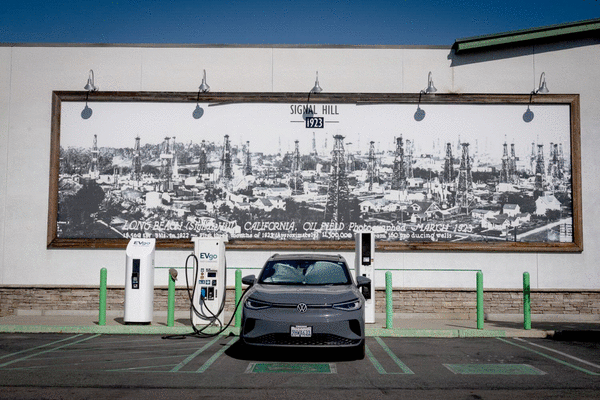
Despite the growing popularity of electric vehicles, such technology continues to receive only scorn and derision from the White House and its acolytes in Congress.
The latest example can be found in a newly unveiled transportation bill that earned a stamp of approval from Rep. Rick Larsen, D-Bellingham, ranking member of the House Transportation and Infrastructure Committee.
As the legislative process grinds on, improvements must be made.
Last month, committee chair Republican Rep. Sam Graves of Missouri and Larsen released a five-year surface transportation reauthorization bill that invests in roads, bridges, transit, rail transportation and safety programs.
Later approved by the committee, the $580 billion measure includes $87.5 billion for transit, $83 billion for local communities to build highways and rail, and $45 billion for bridges among other provisions.
The bill now goes to the full House, but certain elements are already drawing criticism in the Senate, particularly provisions that establish a fee for EVs and repeal several climate-related programs.
The legislation requires an annual fee of $130 for an EV and $35 for a plug-in hybrid electric vehicle, to be collected by the states. Over the years, that increases to $150 and $50.
The ostensible point is to make sure drivers who plug into the grid help fund infrastructure improvements if they don’t pay federal gas taxes. That makes sense. The trouble is: The average American driver pays about $90 annually in federal gas tax.
In Washington, EV and plug-in hybrid electric vehicle drivers are currently hit by an annual state fee of $150, plus an extra $75 transportation electrification fee that supports charging infrastructure.
Last year, there were about 229,000 electric vehicles and 58,000 plug-in hybrids registered in Washington.
When contacted by the editorial board about the reasonableness of the extra EV fee, Larsen responded: “I support the ‘user pays’ principle, and I worked to make sure that the new EV fee in the BUILD America 250 Act is fair and not punitive. Republicans initially proposed a $250 fee, and I negotiated them down to $130. Republicans also proposed eliminating funding for EV charging stations, and I negotiated $1 billion into the bill to expand our nation’s network of EV charging stations.”
That didn’t placate many environmental and consumer groups opposed to the provision.
“Families who are struggling under the weight of rising costs are making exactly the kinds of fuel-saving choices that a well-functioning market should encourage. Imposing new penalties on those choices at this perilous moment would work against the interests of the very Americans Congress is elected to help,” wrote the Natural Resources Defense Council, Sierra Club and others in a letter to Congress.
U.S. Sen. Ron Wyden, D-Ore., said the proposed fee on EVs and hybrids ought to be “off the table.” Sen. Sheldon Whitehouse, D-R.I., stated “slapping a fee on electric vehicles isn’t a solution for the Highway Trust Fund.”
EV owners obviously ought to pay for road maintenance and improvements like everyone else. But forcing them to pay more for no good reason only hurts consumers and puts America farther behind in the global race to cleaner vehicles.
____
©2026 The Seattle Times. Visit seattletimes.com. Distributed by Tribune Content Agency, LLC.



















































Comments