Mac Engel: The Rangers' exclusion of this Hall of Fame candidate feels personal
Published in Baseball
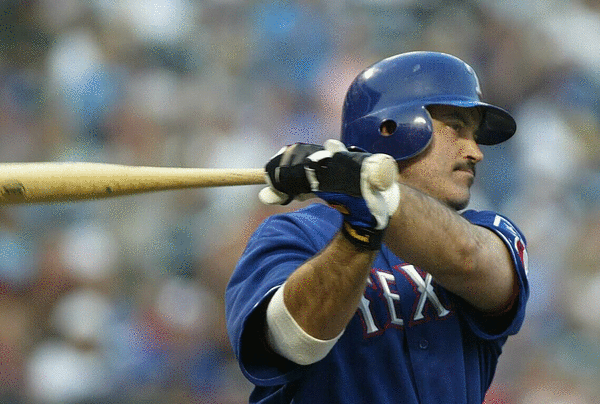
ARLINGTON, Texas — Rafael Palmeiro has every number to be in Cooperstown, but a failed drug test will forever prevent that from happening, and it is used as cover to explain why he is not even in the Texas Rangers Hall of Fame.
Steroids, HGH and other performance-enhancing drugs continue to define this century of Major League Baseball, and the National Baseball Hall of Fame, which has its annual induction ceremony this weekend in New York. Those realities have not prevented the teams themselves from enshrining the guilty, or the allegedly guilty.
In 2017, the St. Louis Cardinals inducted Mark McGwire into their Hall of Fame; the next year, the San Francisco Giants did the same for Barry Bonds, and they retired his jersey. Neither is in the actual Hall of Fame, mostly because they are the faces of baseball’s steroid era.
The Rangers have made no such permissions for Palmeiro, despite a resume that is the color of 1,000 rainbows, including pitch black.
Former longtime Texas Rangers and MLB reporter T.R. Sullivan covered the team, and the sport, for more than 30 years; he recently published a book, “The Texas Rangers and Me,” which includes Palmeiro’s story. Rangers fans will love reading a book written by a man who knows as much about this team as anybody, including Tom Grieve, current broadcaster Eric Nadel and former PR man John Blake.
— True story: During 2001 spring training in Port Charlotte, Fla., T.R. and a bartender debated the career stats of former Boston Red Sox outfielder Carl Yastrzemski. T.R. told the bartender, “Get me a napkin and a pen.” T.R. wrote down Yaz’s batting average, home run and RBI totals. Not career numbers, but every season Yaz had played — all 23 of them.
The bartender opened his Baseball Almanac to check Sullivan’s work; every digit was correct.
Palmeiro’s ruined Hall of Fame case
Palmeiro’s 20-year MLB career ended in 2005, when he was wearing ear plugs with the Orioles to muffle the boos every time he batted.
At that point he was the lying baseball player who defiantly wagged his finger at Congress and denied he took steroids. He didn’t know it then during that congressional hearing in 2005, but he was playing out the string of a brilliant career forever sullied by a drug test he would soon fail; he passionately denied he ever knowingly took steroids.
No one believed Raffy then, or now. The only difference is people have moved on.
It wasn’t shocking because of his infamous denial. It was shocking because he didn’t look the part. No Hulk muscles. No bicep on top of his bicep. Whereas players such as McGwire, Sammy Sosa, Bonds and so many others aced the visual ‘roid test, Raffy looked like an in-shape aging ballplayer.
Once Raffy flunked, it widened the perception problem that any of your favorite players could be ‘roiding either then, or now. Even the skinny ones.
Because of this failed test, he never came close to the needed votes to join Cooperstown. He came off the ballot in 2014, and to gain admission now requires a special committee that is not apt to put him in.
Just like the Giants with Bonds or the Cardinals and McGwire, the Rangers could honor Raffy by inducting him into their HoF. They haven’t for a reason, and it’s not a flunked drug test.
Palmeiro’s denied spot in Rangers Hall of Fame
Palmeiro played half of his career in Texas, and he was one of the more prominent players on solid teams. For the sake of a franchise Hall of Fame, he has the credentials. The numbers. The achievements. The awards.
He also had something else that didn’t show up on the back of a baseball card.
In Sullivan’s book, he writes, “Let’s just say that not everybody viewed Palmeiro as a paragon of virtue who could do no wrong. He wasn’t everybody’s best friend.”
Palmeiro’s envy toward new teammate Alex Rodriguez after he joined the Rangers in the winter of 2000 was unmistakable. When the Rangers promoted prospect first baseman Carlos Pena in the waning days of the ‘01 season, Palmeiro could hardly contain his disgust.
Raffy had an enormous ego and was a remarkable professional hitter who took his job, and craft, seriously. He could also easily display the entitled pettiness of a 7-year-old. This was a player who wanted to be revered as The Man of a franchise, and he was not treated that way. He was treated like a great player, but not its best player.
Then there was the commercial for Viagra, then a new drug in need of a spokesman in 2002. He was the first active athlete to market a drug to treat impotence, and it became a running joke.
“Some in Texas, though, weren’t laughing,” Sullivan writes. “They were just knowingly nodding their head at some marketing executive’s remarkable prescience at selecting Palmeiro for that product. Palmeiro did have a distinctive flair with the opposite sex, and it was not always appreciated by teammates and others.”
There are enough people from his time in Texas still around the Rangers who want to keep Palmeiro’s relationship with the organization at arm’s length. He was recently a guest of the team when it hosted the Nolan Ryan “bloody jersey” promotional night, and he spoke with the media to recount some stories about The Express.
Palmeiro is 61, looks 51 (ish), and while he was a great baseball player, his place in baseball history is messy.
So messy that not only will he never join Cooperstown, but he is still unwanted in the Texas Rangers Hall of Fame.
©2026 Fort Worth Star-Telegram. Visit star-telegram.com. Distributed by Tribune Content Agency, LLC.



Comments