FIFA Men's World Cup: Your guide to understanding soccer
Published in Soccer
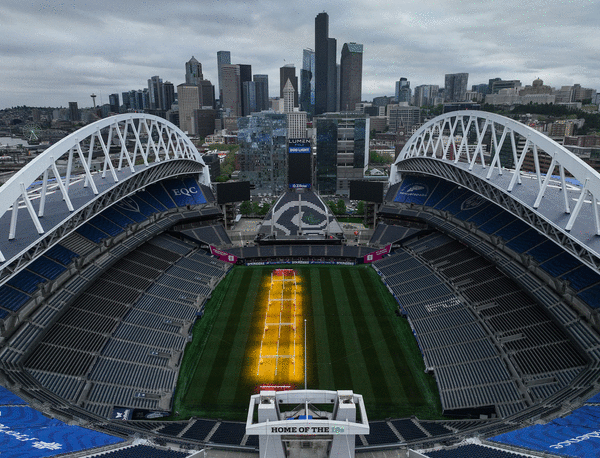
SEATTLE — This week, travelers from all around the world will descend on the United States and Seattle for the FIFA Men's World Cup, the monthlong soccer celebration unmatched in its size, scope and global interest.
The World Cup remains the most watched sporting event in the world. FIFA, the global governing body for the sport, announced more than 5 billion people engaged with the 2022 edition of the tournament across all platforms. Around 1.42 billion fans tuned in for just the World Cup Final between Argentina and France.
For context, more than 125 million people in the United States watched the Seahawks defeat the New England Patriots in the 2026 Super Bowl, the second-most viewed game in the Super Bowl’s history.
But in America, soccer isn’t the sporting behemoth it is around the world. So here’s an explainer for the world’s most beloved sport. O jogo bonito. The beautiful game.
Soccer basics
Known by many names around the world — football, fútbol, fußball, calcio, futebol, to name a few — soccer is a relatively straightforward game.
Eleven players, 10 outfield players and a goalkeeper, try to progress a ball down a field and score it in the opposing team’s goal without using their hands. A ball must completely cross the goal line to count as a goal. Only the goalkeeper, and only while operating inside the 18-yard penalty box, is allowed to use their hands.
Soccer fields are not regulated, meaning they are not all the same size like an American football field or a basketball court. For the World Cup, the touchlines must be at least 105 meters (115 yards or 344 feet) while the bylines — the sides with the goals — must be at least 64 meters (70 yards or 210 feet). The goal frames are 24-feet wide and 8-feet tall.
Fouls like handballs and poor tackles can lead to free kicks, where play temporarily stops and the aggrieved team is given the ball at the spot of the foul. If a player is judged to commit a particularly poor foul, they will be shown a yellow card.
A particularly malicious foul will earn a red card, leading to the player's immediate ejection from the field and forcing their team to play with one fewer player than the opponent for the remainder of the game. Earning two yellow cards in one game also earns an automatic red card.
Additionally, a foul committed by a defending team inside its own 18-yard box results in a penalty kick: a one-on-one attempt on goal by a chosen player from the offense against the opposing goalkeeper from the penalty spot, located 12 yards from the goal line.
Along with fouls, play also stops when the ball goes out of bounds. If it goes out along the touchline, possession changes away from the team that last touched it and the ball reenters the field of play via a throw-in.
If the ball goes out along the byline, it depends which team touched it last. If the attacking team touched it most recently, the defending team gets a goal kick, essentially a free kick by the goalkeeper from their 6-yard box.
If the ball goes off a defender, the attacking team gets a corner kick, effectively a free kick from the corner flag closest to where the ball went out. Corner kicks and free kicks are often referred to as set pieces because they offer teams a chance to run rehearsed plays to create good shots at the goal.
One game lasts 90 minutes and is broken into two 45-minute halves on either side of a 15-minute halftime. Unlike clocked American sports such as basketball and American football, a soccer clock doesn’t stop when the ball goes out of bounds or when play stops for injuries, goal celebrations or fouls. Instead, time is added to the end of the match at the referee’s discretion.
This is called stoppage time. Each half has stoppage time, and the period only ends when the referee decides, usually when neither team has attacking momentum. Essentially, the referee ends the period of play, not the clock.
During the round-robin group stage of the World Cup, games can end in a tie, also called a draw. Wins are worth three points. Draws worth one. Losses worth zero.
But during the second stage of the tournament, the knockout rounds, a winner must be determined. So if a game remains tied after 90 minutes and stoppage time, the teams progress to extra time: two 15-minute overtime periods. It is not sudden death, meaning the first team that scores in extra time doesn’t automatically win. The entire extra 30 minutes — 120 minutes in total — must be played.
If the teams remain tied after extra time, the game advances to penalty kicks. Each team has five opportunities to score a PK. If the teams remain tied after five attempts, players continue to take penalty kicks until one team takes the advantage, ending the game.
What is offside?
Perhaps the most confusing part of soccer for new watchers of the sport, the offside rule was essentially created to prevent cherry-picking — when an offensive player hangs way back to poach goals behind the defense.
An offensive player is ruled offside if they are behind the last defender, not counting the goalkeeper, at the moment a pass is played toward them. When a player is called offside, the opposing team receives a free kick from wherever the offside player was when the foul was called.
Play is only stopped if the offside player interacts with the ball or interferes with the play. Players will wander offside throughout the game, but it is only called as a foul if they are involved in the play. Additionally, an offside player simply needs to move in front of the last defender to return onside and be eligible for a pass.
A brief history of soccer
Humans have been playing games centered on kicking a ball for centuries. The modern iteration of the sport began developing in England, where it grew out of the same folk games that produced rugby.
Attempts to standardize rules for the game started in the mid-1800s, and in 1863, the English Football Association (FA) was founded and created its official laws of the game. Rugby union split from association football — where the term soccer comes from — in 1871.
With defined rules, soccer began to gain popularity in England. The FA Cup, a competition still held to this day, was first contested in 1872. Soccer in England began professionalizing in 1885, and three years later in 1888, the football league first division — the predecessor of the English Premier League — was founded.
English sailors, merchants and teachers helped spread the game around the globe. Members of the English community in Argentina organized a league in 1891, the first outside of England. FIFA, the sport’s governing body, was founded in Europe in 1904 despite English resistance, and in 1908, the sport was made an official part of the Olympics for the first time.
The sport’s popularity exploded after World War I. In 1930, FIFA held the first World Cup in Montevideo, Uruguay, where the host nation won the first iteration of the tournament. The United States, which established the first professional league outside of England in 1921, came in third.
© 2026 The Seattle Times. Visit www.seattletimes.com. Distributed by Tribune Content Agency, LLC.





Comments