Trump administration sues Philadelphia over 'ICE Out' face mask ban for law enforcement
Published in News & Features
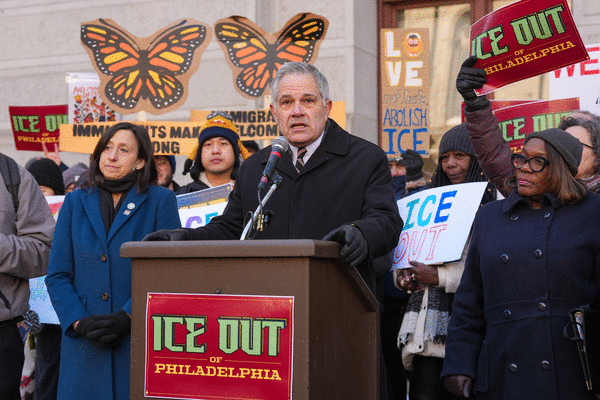
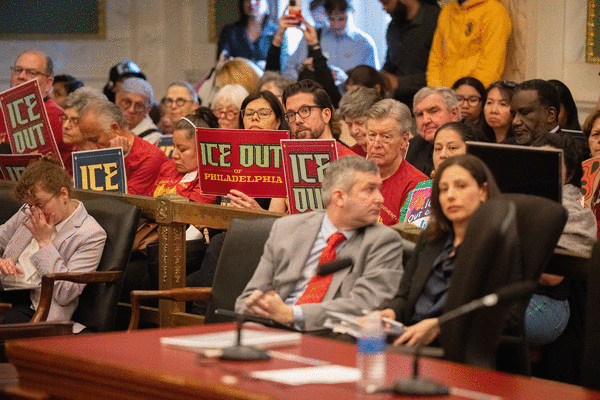

PHILADELPHIA — President Donald Trump’s administration sued Philadelphia and some of its top officials Thursday over a new ordinance that bars law enforcement officers from concealing their identities and effectively bans federal immigration agents from wearing masks.
The law, part of City Council’s recently adopted “ICE Out” package of legislation imposing some of the nation’s toughest local restrictions on immigration agents, is “blatantly unconstitutional,” the lawsuit said.
“Such an ordinance also undermines the principles of federalism that underlie our entire constitutional order by seeking to prevent effective federal law enforcement within Philadelphia,” according to the complaint.
The ordinance makes it a crime for any law enforcement officer, including Immigration and Customs Enforcement agents, to wear face coverings or conceal personal identifiers like badges and nameplates while carrying out their official duties in the city, and it requires officers to identify themselves. It also prohibits the use of unmarked vehicles.
The bill includes exceptions allowing officers to wear masks in certain circumstances, such as medical emergencies or SWAT operations.
An officer who violates the ordinance could be prosecuted, and risks up to 90 days in jail plus a fine.
The suit, filed in the Eastern District of Pennsylvania, names as defendants the city, Mayor Cherelle L. Parker, District Attorney Larry Krasner, and City Solicitor Renee Garcia. It asks a federal judge to find the bills unconstitutional, warning that federal agents could suffer irreparable harm if the policy remains in place.
“Protecting officers’ personal identities is particularly important during high-risk enforcement operations involving individuals with violent criminal history, gang affiliations, transnational criminal organizations, and known or suspected terrorists,” the suit says.
The lawsuit marks the Trump administration’s most significant action targeting Philadelphia’s immigrant-friendly policies to date.
“Today we regrettably had to sue the birthplace of this great Nation,” Associate Attorney General Stanley Woodward said in a statement. “But we will not sit by while Philadelphia flagrantly violates our Constitution, seeking to criminally punish our Nation’s law enforcement heroes merely for doing their job.”
Philadelphia has long been known as a sanctuary city primarily because it does not comply with ICE-issued detainers, in which federal agents ask local jails to facilitate the arrest of undocumented immigrants in their custody.
But Parker has largely avoided direct confrontation with the White House over the issue, a reversal from the combative stance of her predecessor, former Mayor Jim Kenney.
Parker’s supporters credit her with careful, crafty management of the city’s relationship with Trump, noting Philadelphia has been spared from the surges of federal agents the president has sent to other cities. But immigration advocates say Parker has backed away from a fight at a time when strong action is most needed.
The tension surfaced when Parker decided to let the mask bill became law without her signature, after Garcia warned the mayor that the provisions might not be legally enforceable.
Council members, however, wanted to take a more proactive stance against Trump’s nationwide deportation campaign. And they seem to have gotten his attention.
Councilmember Kendra Brooks, who coauthored the “ICE Out” package, said she “will not back down from this fight.”
“Philadelphia doesn’t like bullies. And we certainly don’t like masked PPD officers or ICE agents terrorizing our neighbors,” Brooks said in a statement. “The people of this city expected our leaders to fight back against Trump’s invasion. That’s what we did when we passed ICE Out.”
Brooks noted that the lawsuit cites the Parker administration’s publicly aired concerns about the bill, and said other jurisdictions targeted by Trump after they passed legislation restraining ICE have not had to deal with that dynamic.
“Other lawsuits aren’t dealing with the City’s own words about the laws being used against them,” Brooks said.
The Parker administration declined to comment.
The Pennsylvania Immigration Coalition condemned the lawsuit as a political effort to undermine local policies that keep families safe, strengthen public trust, and ensure city resources serve Philadelphians.
“Once again the Trump administration is using the courts to wage a political campaign against immigrant communities, instead of addressing the real needs of our country,” coalition executive director Jasmine Rivera said in a statement. “Pennsylvanians have been clear, they do not want more immigration enforcement and detention centers, they want affordable education, healthcare, and housing.”
Councilmember Rue Landau, the legislation’s other coauthor, criticized Trump for “targeting Philadelphia because our city dared to stand up and say that masked federal agents should not be able to operate in our communities and target our vulnerable neighbors without accountability.”
In addition to banning officers from concealing their identities, the “ICE Out” package, which in April passed Council with a veto-proof supermajority, prohibits federal immigration agencies from staging raids on city-owned property, bans discrimination on the basis of citizenship status, and prohibits the city from engaging in most forms of information-sharing with ICE.
The legislation also codified some of Philadelphia’s long-standing sanctuary city policies that had been established only through executive order — most notably a ban on city jails honoring ICE detainers not accompanied by judicial warrants.
Parker signed six of the seven bills in May, and allowed the ban on agents hiding their identities to become law without her signature.
Parker did not sign the bill after Garcia expressed concern about the ban’s “significant legal and operational challenges,” the suit notes. The mayor’s signature would signal the Parker administration’s intent to enforce the requirement, the solicitor said, and would send an inaccurate signal that the prohibition was enforceable.
While Parker might have attempted to distance herself from the requirement by not signing the bill, the lawsuit quotes Krasner threatening federal agents with prosecution.
“We will arrest you. We will put handcuffs on you. We will close those cuffs. We will put you in a cell,” Krasner said in January. “We will do everything in our power to convict you and we will make sure you serve your entire sentence because Donald Trump has no power whatsoever to pardon you.”
The complaint makes clear that by bringing this lawsuit, the Department of Justice is not closing the door on challenges to other ICE Out ordinances.
Around the country, more and more Democratic-led communities are attempting to regulate what ICE can and cannot do within their jurisdictions. And doing so with the support of immigrant communities.
“In all the ways that ICE agents terrorize and violate the rights of our community, masked kidnappings are ones we consistently see and hear about,” said Erika Guadalupe Núñez, executive director of Juntos, the South- Philadelphia-based immigrant advocacy organization.
She said, however, that “we’re part of a strong local movement organized to fight back, and we all embody the spirit of this city, we will not back down easily.”
In March, the Montgomery County Board of Commissioners passed a resolution that restricted the agency from using county property or resources for civil investigations.
Issues around masks and identification have been particularly contentious.
Activists in Philadelphia and elsewhere say ICE arrests often look like kidnappings or muggings, where men in ordinary clothes, with no visible identification, suddenly descend on their target. The people being arrested may think they are being attacked by criminals.
Several states, including New Jersey and New York, have passed laws to ban law enforcement officers, including ICE, from wearing facial coverings while on duty.
In April, the U.S. Court of Appeals for the 9th Circuit upheld a lower court’s injunction on a California law that required federal agents to “visibly display identification.” The unanimous three-judge panel ruled that the requirement violated the Constitution’s supremacy clause, which bars the states from regulating federal government activities.
New Jersey Gov. Mikie Sherrill signed bills in March that essentially banned ICE agents and police from wearing masks on the job, drawing pushback from Republican lawmakers. The Trump administration sued New Jersey in federal court in April, and the New Jersey Monitor and others reported that ICE agents continued to cover their faces during recent clashes with demonstrators outside the Delaney Hall immigrant detention center in Newark.
The Trump administration says federal immigration officers wear face coverings to protect themselves and their families from anti-ICE activists who may seek to identify and harm them. Assaults and death threats are on the rise, the administration said.
©2026 The Philadelphia Inquirer. Visit inquirer.com. Distributed by Tribune Content Agency, LLC.




Comments