The B-52 bomber is an iconic, aging warhorse. Probe of fatal crash could influence its future
Published in News & Features
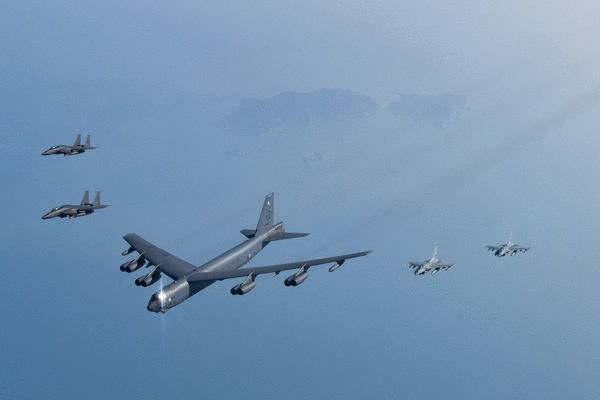
LOS ANGELES — The B-52 bomber is considered a marvel not only of the U.S. military but of all aviation history.
The massive plane remains a workhorse for the Air Force seven decades after it debuted in the 1950s, and military officials believe the fleet can continue through the century mark with regular modifications and modernization.
Prized for their payloads, long ranges and ability to fly at high altitudes, B-52s have played a role in many U.S. conflicts, including the war with Iran.
Now, an inquiry into why a B-52 Stratofortress crashed Monday shortly after takeoff at Edwards Air Force Base, killing eight, is renewing questions about the 70-year-old planes, their purpose in the rapidly modernizing military landscape and their future.
Experts say the probe will likely include a review of the entire aging heavy bomber fleet, including past and upcoming upgrades to the plane that the Air Force has called the "backbone" of its manned bomber force.
"The problem is that you do the math, and equipment that was bought in the Cold War is getting pretty old, and there comes a point where these front-line aircraft, they wear out," said Douglas Birkey, executive director of the Mitchell Institute for Aerospace Studies. "Structurally, can the aircraft hang together until 2050, where they have it projected? Well, no one really knows."
There is little doubt the B-52 will continue its epic run. The Air Force is currently working toward the newest version of the bomber, testing a new radar system and working with contractors to update its 1960s-era engines.
"If you take care of an airplane, you can fly them forever," said Ross Aimer, a retired United Airlines pilot and chief executive of Aero Consulting Experts. But, he added, constant updates to the original frame of the B-52 could also cause issues that need to be probed.
Exactly what caused the B-52 Stratofortress to crash shortly after takeoff Monday during a routine test mission remains unknown, but Edwards Air Force Base officials said the crash is under investigation by an Interim Safety Investigation Board within the Air Force.
Unlike crashes involving private and commercial planes, the National Transportation Safety Board does not investigate military plane crashes. Instead, those investigations are handled by an internal group of Air Force specialists tasked with collecting evidence, preserving it and interviewing witnesses.
That evidence could include what is commonly known as a "black box." An Edwards Air Force Base spokesperson said the B-52 Stratofortress that crashed Monday was in fact equipped with the military equivalent of a "black box," but was unable to confirm whether investigators have been able to recover it from the wreckage.
Birkey and others said the investigation will also likely include not just inspection of the wreckage, but a review of past incidents involving the crashed plane, as well as an analysis of past incidents involving the rest of the B-52 Stratofortress fleet.
How deep that review goes, experts said, will largely depend on what investigators find on the ground.
"They're going to have to do a very thorough inspection of the fleet," Birkey said. "If they think it's something structural or mechanical, it could cause extra inspection."
Experts said the inquiry could include a deeper review of the entire B-52 program. First flown in 1954, the B-52 has played an instrumental role in every U.S. armed conflict for decades. Since then, the heavy bomber has undergone more than half a dozen transformations to align its technology with the military's changing needs.
Testing for the new radar system is already underway, while tests for the plane's new engines are expected to begin in 2027.
Edwards Air Force Base officials said the plane that crashed Monday was conducting a routine test mission for its Radar Modernization Program. On Wednesday, Air Force officials identified the eight-member crew on board, which included flight test engineers, pilots, two Boeing contractors and multiple members of the 419th Flight Test Squadron.
The aircraft has kept a vital spot in the Air Force for two main reasons, Birkey said. Its long range, ability to be refueled mid-flight and capacity to carry large payloads have made it crucial in past U.S. wars. The prospective high cost of developing and constructing a new heavy bomber with similar features, he said, has also led military officials to opt instead for upgrading the current aging fleet.
But Birkey said the crash investigation would consider those questions, including whether any issues discovered in the crashed aircraft could exist across the entire fleet or are unique to the circumstances during Monday's crash.
"They're going to try to piece together what happened," Birkey said.
Birkey said airplanes undergoing testing are often equipped with additional devices that record various types of data because military officials and contractors are trying to collect as much information as they can about the aircraft and its systems.
"They're pretty wired up," Birkey said, adding that the plane may have been equipped with additional sensors to record information.
But experts point out that, unlike investigations of civilian aircraft, which often include a published report, the military investigation into Monday's crash may not become public.
According to the Air Force, the Interim Safety Board assigned to investigate the crash is tasked with collecting as much information as possible and then handing it over to a Safety Investigation Board, composed of experts, that will complete the inquiry.
That handover to a Safety Investigation Board is expected to occur this weekend, a base spokesperson said.
But Aimer and other aviation experts point out that, despite its age, the B-52s have an impressive safety record, with few known incidents and crashes.
Before Monday's deadly crash, the most recent incident involving a B-52 occurred in 2016 in Guam, after the plane overran the runway. Another B-52 crashed in Guam in 2008, killing six.
"Let's be honest, reimagining and changing an old airplane, it would be like putting chrome wheels in a Honda Civic from the late '70s," Aimer said. "It's still a Honda Civic."
If there is an existential crisis for the iconic B-52 after the most recent crash, Aimer said it is more likely to come from the changing landscape of war and technology.
The bigger and most recent threat to the B-52's existence occurred not at Edwards Air Force Base, but in Iran. While the bombers were part of the campaign, they were far from the only warriors.
"They may at some point decide, this is too much of an upgrade, when we can concentrate on drones instead of long-distance bombers," Aimer said. "I think the days of sending the Marines and the B-52 might be over. We may have learned a sad lesson with the war in Iran."
©2026 Los Angeles Times. Visit at latimes.com. Distributed by Tribune Content Agency, LLC.






Comments