Rights group raises alarm over growing US security partnership with Ecuador
Published in News & Features
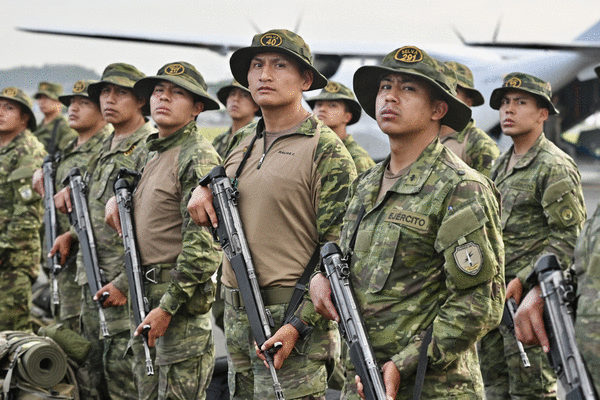
Human Rights Watch is pressing lawmakers in Washington to open an inquiry into America’s growing security role in Ecuador, arguing that joint counter-crime missions have unfolded with far too little oversight and too few guardrails to keep civilians safe.
The watchdog group laid out its case in a nearly 100-page report titled “A Dangerous Partnership: Abuses, Unanswered Questions, and US-Ecuador Security Cooperation.” It documents claims that Ecuadorian troops tortured civilians during a joint operation near the Colombian border, and it raises pointed questions about mysterious drone strikes on Ecuadorian fishing boats in the Pacific — attacks whose survivors say ended with their being held aboard a ship crewed by armed Americans.
Human Rights Watch Americas Director Juanita Goebertus offered a blunt assessment, arguing that the security relationship has operated with far too little transparency, endangered Ecuadorian civilians, and warrants greater congressional scrutiny before further harm occurs.
Alliance under scrutiny
The report arrives as the security bond between Washington and Quito has deepened sharply under the Trump administration, which has cast the partnership as essential to fighting drug trafficking and organized crime in a nation gripped by an extraordinary surge in violence.
Human Rights Watch contends that disclosure has not kept up with the pace of cooperation. Both governments, it says, have increasingly treated the crackdown on organized crime as though it were on a war footing, loosening the rules governing use of force in ways that raise the odds of serious abuses.
To build its case, the organization conducted 62 interviews with victims, witnesses, lawyers and officials, and reviewed over 100 photos and videos alongside satellite imagery, ship-tracking data, fire-detection records, medical files and court documents. It says it asked both Washington and Quito for comment but received nothing back.
The scale of Ecuador’s collapse into violence is stark: The country logged 1,189 homicides in 2019, a figure that had ballooned past 9,200 by 2025, giving it the hemisphere’s second-highest murder rate, trailing only Haiti. Extortion, kidnapping and cocaine trafficking through the country have surged in tandem.
In response, President Daniel Noboa declared an “internal armed conflict,” sent the military into the streets nationwide and broadened security forces’ authority. Human Rights Watch notes that this legal designation has since been questioned by both Ecuadorian courts and United Nations experts, who doubt the crisis actually meets the international legal bar for armed conflict.
Torture allegations
The report’s most detailed case comes from San Martín, a rural community in Sucumbíos province along the Colombian border, where a joint military operation ran from March 1–6.
Four Colombian dairy workers were arbitrarily detained, according to the report, during a mission billed as targeting the Border Commands, an armed criminal group active along the border. Investigators say the men were beaten, shocked with electric jolts, threatened with mutilation, and subjected to mock executions — then released without ever being charged.
One worker described being shocked repeatedly with a taser and doused with water beforehand, saying he blacked out more than once. Another said soldiers threatened to remove his fingers or fingernails while pressing him for information on weapons and drugs, and a third said a soldier held a gun to his head, cocked it and pulled the trigger in what he took to be a staged execution.
Forensic reviewers from the Independent Forensic Expert Group, along with medical records and injury photos gathered by Human Rights Watch, back up the men’s accounts of being beaten in custody.
Days later, the military destroyed the farm where the men worked, along with two other properties, insisting all three had served as training grounds for the Border Commands. Human Rights Watch says its own evidence — satellite images, receipts, interviews and photos — instead shows a functioning dairy operation with no visible ties to organized crime, and that the other two sites had simply sat abandoned for years.
Ecuadorian officials maintain the detentions were justified by suspected links to the armed group. U.S. Southern Command chief Gen. Francis L. Donovan later told the Senate Armed Services Committee the operation had been carried out well. Prosecutors ultimately dropped the matter, citing a lack of evidence and the workers’ clean criminal records.
Unexplained violence at sea
A second thread of the report examines three incidents off the Galápagos Islands between January and March.
Two fishing boats, the La Negra Francisca Duarte II and the Don Maca, were reportedly struck by armed drones, injuring at least four crew members. A third vessel, the Fiorella, vanished on Jan. 20 with eight crew members still unaccounted for.
Survivors say that after the strikes, a boat flying a U.S. flag approached, and armed, English-speaking personnel forced them aboard at gunpoint — handcuffing and hooding them, making some kneel for hours on a scorching metal deck, before eventually transferring them to the Salvadoran Coast Guard and, later, back to Ecuador. One survivor recalled being questioned about casualties even as rifles were trained on the group.
Both the Pentagon and the U.S. Coast Guard have denied any role in the drone strikes or the Fiorella’s disappearance, and Ecuadorian officials have not confirmed the incidents occurred at all. Human Rights Watch says it could not pin down who launched the drones or identify the mystery vessel, but argues the survivors’ consistent accounts point to likely American involvement or awareness — and that the unanswered questions alone justify a full, transparent investigation.
Human Rights Watch places these episodes within a wider trend: Complaints of excessive force and extrajudicial killings by Ecuadorian security forces reportedly more than doubled after Noboa’s 2024 armed-conflict declaration. The group also points to UN. concerns over forced disappearances and cites the notorious Guayaquil case, in which four boys detained by soldiers were later found dead — a case that led to convictions of 16 military personnel.
The organization is calling on both governments to be far more forthcoming about the scope of their cooperation, to clarify what role U.S. personnel actually play in joint missions, and to spell out what safeguards exist to prevent future abuse. It wants Congress specifically to examine whether the expanding military relationship includes meaningful human rights protections.
As Goebertus put it, joint security operations targeting organized crime should never become a shield for abuse.
©2026 Miami Herald. Visit at miamiherald.com. Distributed by Tribune Content Agency, LLC.





Comments