As parasite spawned chaos, Taylor Farms slow-walked its response
Published in News & Features
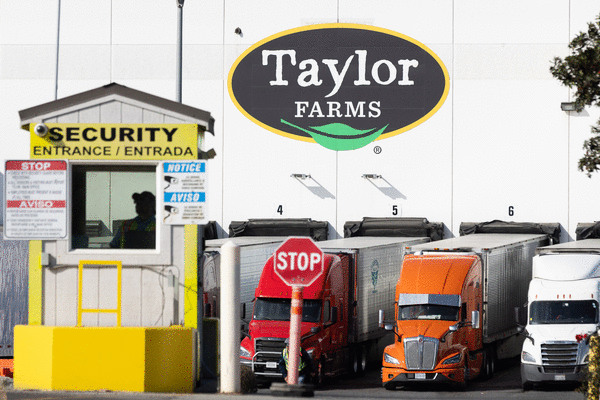
The U.S. Food and Drug Administration had apologized, Taylor Farms said in a post on X. An agency lab test linking its produce to the country’s worst cyclosporiasis outbreak in decades was a false positive. Not only that, but the government still hadn’t produced a laboratory result connecting the company’s lettuce to the outbreak.
The statement, issued Sunday, was a remarkable bid to give the impression that regulators — who had said significant evidence linked Taylor Farms iceberg lettuce to the public health crisis — had made key scientific errors.
By Tuesday, the X post was deleted.
That was after a rebuke by the FDA, which denied ever apologizing to the company. The agency defended its work and explained that the incorrect lab result would only have expanded an existing recall — it didn’t clear Taylor Farms. The FDA also sought to clarify other statements from Taylor Farms that experts have said are misleading.
The parasite-caused gastrointestinal illness can cause severe diarrhea. It’s sickened thousands and hospitalized more than 100.
As case counts jumped, the company effectively delayed a recall that ultimately resulted in customer confusion, according to a U.S. official who asked not to be identified. Taylor Farms has done so by challenging the science privately and obfuscating it publicly, the official said.
A Taylor Farms representative last week said the company met with FDA and White House officials “to discuss the best approach to ensure public health.” The company declined to comment further for this story.
“One laboratory test produced a false-positive result for a shipment of Taylor Farms lettuce that was outside the scope of the current recall, and FDA promptly notified the company after receiving that result,” Health and Human Services spokesperson Emily Hilliard said in a statement. The corrected result, she added, didn’t change the agency’s determination.
“The communications from Taylor Farms have been confusing,” said Susan Mayne, the former director of what was then called FDA’s Center for Food Safety and Applied Nutrition. “The recall notice is perhaps the most obtuse recall notice I recall ever seeing.”
When the FDA first tied Taylor Farms’ operations in central Mexico to a large cluster of cyclosporiasis cases in Michigan and neighboring states, the farming conglomerate missed a regulator-imposed deadline to take action. At some point Taylor Farms directly spoke to the White House, and later the FDA and Centers for Disease Control and Prevention were asked to defend their evidence. The back-and-forth ultimately kept the public in the dark an additional 60 hours, the U.S. health official said.
The company also issued a preliminary statement that stopped short of explicitly declaring a recall of potentially tainted lettuce, before providing additional details later amid scrutiny. And Taylor Farms has now moved to delete social media posts that left some consumers confused over whether their lettuce was in fact tied to the outbreak.
Founded in 1995 in the Salinas Valley of California, Taylor Farms — the business name of Taylor Fresh Foods, Inc. — has 20,000 employees and sells produce in major supermarkets across the U.S., as well as supplying restaurants and other food service providers. The company calls itself “the leading global producer of salads and healthy fresh foods” on its website and has production facilities across the U.S., Canada and Mexico.
Last Wednesday, representatives from the CDC and FDA reached out to the company to discuss the outbreak. Officials had surveyed hundreds of patients struck with cyclosporiasis infections across the Midwest, and found a common theme — many of those now gripped by gut-wrenching stomach cramps had eaten at Taco Bell.
Federal officials outlined to Taylor Farms representatives that they believed the culprit was iceberg lettuce the company provided to Taco Bell locations in Indiana, Kentucky, Michigan, Ohio and West Virginia; the sheer number of patients reporting meals at the Mexican-style fast-food chain convinced them it was no coincidence.
A recall would not only be costly — it would indelibly link Taylor Farms to the phrase “explosive diarrhea” in the minds of American consumers.
Missed Deadline
The administration gave Taylor Farms a deadline to initiate a voluntary recall before noon the next day, the U.S. health official said. The parasite had been detected in 34 states, and health authorities were urgently investigating potential sources.
Then the White House got involved. The California-based food processor already had ties to President Donald Trump.
Taylor Farms gave $1 million to a political action committee supporting the president last year. Chief Executive Officer Bruce Taylor had attended an event with Agriculture Secretary Brooke Rollins and hundreds of agriculture executives, members of Congress, and federal staff just days earlier, celebrating 250 years of American farming at Mount Vernon.
The initial deadline for Taylor Farms to initiate the voluntary recall or take a product action — Thursday at noon — came and went.
Still, health agency officials continued to coordinate a statement they planned to release late in the day.
A pair of White House officials convened a call with the FDA and the CDC, according to people familiar with the matter. The White House aides asked administration health officials to walk through specific evidence linking the outbreak to the lettuce, and wanted to review drafts of the coming press releases.
Within hours, the White House agreed the patient surveys painted a clear picture, the people said. In an internal call, the White House aides approved statements from the public health agencies for public release — though they still only identified Taco Bell as linked to the outbreak, without naming Taylor Farms specifically.
Taco Bell moved first, releasing a statement. While it did not explicitly name Taylor Farms it said it believed “public health is a shared responsibility among restaurants, their suppliers, and authorities, and we are proud to have consistently acted quickly and proactively to protect our guests.”
The agency updates on the outbreak were finally posted after 10 p.m. New York time — hours behind schedule — and also omitted directly naming Taylor Farms or saying if the company would recall products.
A Taylor Farms representative said last week that it didn’t request to be omitted from public statements.
A White House official, speaking on the condition of anonymity, described Taylor Farms as defensive through the process and stressed that Trump himself had not been in touch with the company.
By Friday afternoon, following numerous news articles linking the company to the outbreak, Taylor Farms issued a statement saying that based on information provided by the FDA, the company was “voluntarily removing all iceberg lettuce sourced from central Mexico.”
It emphasized that “no Taylor Farms branded salads or kits are associated with this outbreak” and that none of the kits contained iceberg lettuce. FDA tracing, Taylor Farms said, indicated a specific independent farm in Mexico was responsible.
But the statement only seemed to prompt additional questions. It did not explicitly concede the company’s lettuce had been tainted or call it an official recall, or explain whether non-branded kits were vulnerable and what, if any, products consumers should discard.
The FDA subsequently released its own notice referring to a Taylor Farms “recall.” Hours later, the company issued a follow-up statement with an explicit recall of all iceberg lettuce sourced from central Mexico that included products distributed across 27 states under eight different brands.
“The recall notice that came out at the end of that process is inadequate,” Mayne said.
And while Taylor Farms initially left the impression its bagged lettuce sold in retail stores would not be included in the recall, the subsequent announcement indicated it wanted some retail products pulled off shelves.
Food Safety
On Saturday, Walmart Inc. told Bloomberg News it had removed four bagged salads after receiving a notice from Taylor Farms. Other companies including food service provider Sysco Corp. were named on the recall notice in the confusing list of acronyms.
“At the direction of Taylor Farms, the only product subject to recall are Taylor Farms processed iceberg lettuce products from Mexico, which remain unavailable for sale or distribution,” Sysco said in a statement, adding that it informed customers of the recall.
The initial vagueness in Taylor Farms’ communications seemed to underscore the extent to which a recall posed a risk to a company that has marketed itself as oriented around food safety.
Bruce Taylor helped launch the Center for Produce Safety and a statewide marketing agreement to standardize industry safety practices, and the company sells a proprietary anti-contamination system called SmartWash.
Taylor Farms already recalled some yellow onion batches produced in a Colorado facility in response to a 2024 deadly outbreak of E. coli linked to some McDonald’s Corp. burgers that sickened more than 100 people across 14 states.
Whatever doubt remained appeared to evaporate by Saturday. A sample of shredded iceberg lettuce collected by the FDA during targeted surveillance of Mexican produce imported from a Taylor Farms facility tested positive. The impacted lettuce wasn’t involved in the initial recall, suggesting Taylor Farms would likely need to expand the removal efforts.
But on Sunday, federal scientists conceded it had been a false positive. Food safety experts say that isn’t surprising — cyclospora is notoriously difficult to detect and false positives occur regularly. The company seized on the admission, releasing a new statement claiming the “FDA apologized to us.”
“We were informed that FDA made a mistake, and this was a false positive. To be clear, at this moment, FDA has not identified a single positive product test result for Cyclospora,” the company said.
The FDA on Monday took to social media, disputing the notion the false positive absolved Taylor Farms of responsibility. An FDA official also insisted to reporters the agency did not provide a formal apology to the company.
There is “overwhelming epidemiological data supporting the current voluntary recall by Taylor Farms,” the agency said. The traceback investigation and outbreak data “continue to converge on shredded iceberg lettuce from Taylor Farms locations in central Mexico.”
“I have not seen this amount of misinformation about an outbreak in my time at the FDA, where consumers are so broadly confused,” Mayne said.
The confusion was partly the fault of the FDA’s weekend communications, she said, “but really compounded by Taylor Farms communications, that signaled a very different message than what FDA had intended to communicate.”
____
(With assistance from Daniela Sirtori, Skylar Woodhouse and Rachel Cohrs Zhang.)
©2026 Bloomberg L.P. Visit bloomberg.com. Distributed by Tribune Content Agency, LLC.



Comments