US widens strikes on Iran as both sides downplay diplomacy
Published in News & Features
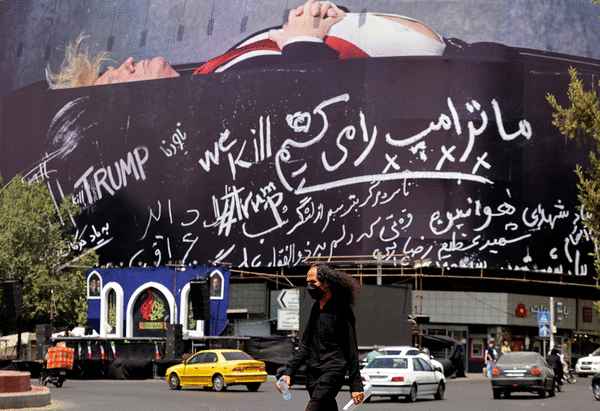
The U.S. widened the scope of its airstrikes on Iran overnight, as President Donald Trump and officials in Tehran signaled a renewal of peace talks is unlikely in the near-term.
American forces struck a military site near the north-western city of Tabriz, according to Iranian media, the first time the area is thought to have been hit since hostilities between the warring sides worsened two weeks ago.
The Iranian government activated air defenses early on Wednesday in Tehran, the capital, local media reported, adding that the U.S. struck Abdanan and Chovar in the west, near the border with Iraq.
That was the 11th straight day of attacks on Iran, which again fired on U.S. bases in Kuwait, Bahrain and Jordan.
Iran’s Interior Minister Eskandar Momeni visited Pakistan — the main mediator in the conflict along with Qatar — on Tuesday but there was no sign his meetings had deescalated tensions.
“There are no negotiations — it’s only possible for there to be an exchange of messages,” a spokesman for the ministry said after the visit, according to semi-official Mehr news agency. “Our new message is that the enemy violated the memorandum and should implement it,” he added, referring to the June 17 interim peace agreement that’s now effectively obsolete.
Oil prices have jumped in the past fortnight and Brent crude traded up 2.7% to close to $94 a barrel in London on Wednesday. Refined fuel prices, including wholesale diesel in Europe, are also surging.
Bond markets have reacted, with U.S. 10- and 30-year Treasury yields rising to roughly two-month highs on concern inflationary pressures will prompt the Federal Reserve to raise interest rates.
The U.S. says it will intensify its bombing campaign until Iran agrees to reopen the Strait of Hormuz and stop attacking energy tankers and other ships going through the vital waterway. So far, Iran isn’t backing down and has dismissed Trump’s claims it’s seeking a new round of negotiations.
The Iran-backed Houthis, meanwhile, have threatened to open another front in the war, telling shippers they could be targeted if they try to call at Saudi Arabian ports. The Yemen-based group is now ready for maritime attacks from positions near the Bab el-Mandeb strait at the southern end of the Red Sea, according to an alert from the Joint Maritime Information Center, a global monitoring body for naval security.
Trump says U.S. operations are seriously degrading Iran’s military power, even as the Islamic Republic continues firing on ships in Hormuz. Tehran is also causing extensive harm to U.S. troops and bases. Late Tuesday, the Pentagon said an army sergeant was believed to have been killed last Friday during an attack on an air base in Jordan. The 28-year-old soldier had been announced as missing until then.
Her death is the fourth U.S. fatality over the past week, with two other troops being killed in Jordan, and another dying from an attack on northern Iraq.
Iran says the 11 days of U.S. attacks have killed more than 50 people and wounded more than 500.
Trump said Tuesday in response to a question that Iran “probably” is trying to influence the midterm elections in November with its attacks in the strait, which have pushed up U.S. gasoline prices. He reiterated more military action is likely and suggested he’d strike Pickaxe Mountain, which the U.S. and Israel suspect is a nuclear site.
“If we left tomorrow, we had a big, we had a big success,” Trump said of Iran. “But we’re not leaving tomorrow.”
Iran vowed to respond with a “powerful strike” to any attack on its nuclear facilities or other sensitive infrastructure.
If the U.S. sets foot on Iranian soil, “it will face millions of people who will confront them with everything they have,” state TV cited Army Commander-in-Chief Amir Hatami as saying.
U.S. Defense Secretary Pete Hegseth told senators on Tuesday that the war had cost Washington $37.5 billion so far. In late May, government officials had put that figure at $29 billion, which some experts criticized as an understatement. Hegseth was on Capitol Hill pushing for a $67 billion supplemental defense-spending bill.
—With assistance from Raeedah Wahid, Tom Fevrier and Vivien Ngo.
©2026 Bloomberg L.P. Visit bloomberg.com. Distributed by Tribune Content Agency, LLC.





Comments