Illinois Speaker Welch tries to contain fallout over handling of Harry Benton harassment allegations
Published in News & Features
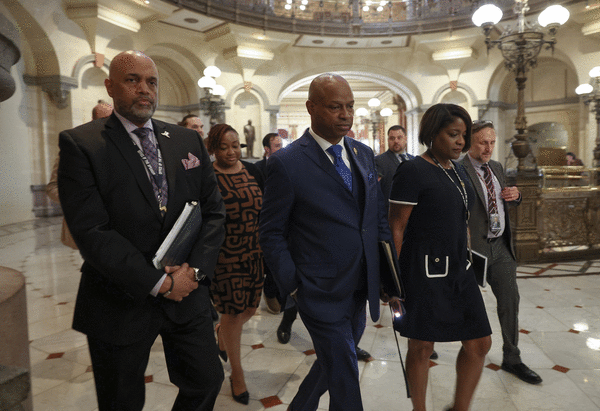
Illinois House Speaker Emanuel “Chris” Welch, seeking to contain political fallout over his handling of sexual harassment complaints against former state Rep. Harry Benton, held outreach meetings with Democratic caucuses Tuesday, telling members that delays in taking action against Benton stemmed from the wishes of a now-former Benton staffer who first reported the allegations three years ago.
Welch said his office waited three months after the female staffer notified his office of a lengthy list of harassment allegations before taking any action, because the young woman said she wanted the speaker’s office to wait until she had left her job, according to several Democratic House members who spoke on condition of anonymity to avoid repercussions.
But the former Benton staffer told the Tribune on Tuesday she did not recall telling the speaker’s office to delay taking action and, just weeks after filing her initial report of harassment allegations against the former Plainfield Democrat, she told the speaker’s office about additional inappropriate comments she experienced with Benton. She has said Welch took no action on her complaints.
Welch also told lawmakers he had acted to respect the former staffer’s wishes not to “pursue” action against Benton. But she said that was in reference to her rejecting Welch’s office’s push for her to file a report with the legislative inspector general’s office. She has said she preferred that Welch’s office handle the matter internally and further stated that she didn’t want other women to face harassment from Benton in the future.
“I genuinely, to the best of my knowledge, I don’t remember saying, ‘Wait till I left,’” the former staffer, who left Benton’s office after only six months on the job, said Tuesday of her prior dealings with Welch’s office.
“I was very anxious at the time. It was very stressful, my departure from the office. But I do not recall saying, ‘Wait to take action,’” she said. “But regardless, I feel that they had an obligation to do something, and even what they ended up doing, the conversation (with Benton) that they did or did not have about his … sexually harassing me and other women, obviously, they did not do enough at the time.
“But victim blaming is never the answer for someone in (Welch’s) position, the position of power. He is a leader,” she said.
The Tribune is not identifying the woman because she has requested anonymity and is a victim of sexual harassment.
Welch’s meetings with Democratic members come in the wake of a recent Tribune investigation that detailed how the speaker’s office knew of harassment complaints against Benton three years ago but did nothing at the time, according to the former staffer. The speaker backed Benton’s narrow 2024 reelection bid with $1 million in campaign funds.
It wasn’t until Welch’s office received complaints that Benton had engaged in a lewd conversation with a lobbyist at a River North Chicago bar in February of this year that his office took action. Welch removed Benton from caucus and committee assignments and filed a complaint with the legislative inspector general. After that IG investigation was turned over to the speaker’s office on July 1, Welch called for Benton to resign, which Benton did several days later. Benton also dropped his 2026 reelection campaign.
The Legislative Ethics Commission — a bipartisan group of eight members from each of the four House and Senate Democratic and Republican caucuses — is expected to vote on whether to publicly release the IG report. Among those who have called for its public release are Welch and Gov. JB Pritzker.
In a letter to members of the House Democratic majority sent Monday, Welch contended the legislative inspector general’s report would vindicate his office’s actions involving Benton.
“The report will confirm that, throughout the process, our office followed the appropriate steps to act quickly while protecting, respecting, and safeguarding the privacy and dignity of individuals who courageously spoke out,” Welch wrote in the letter, a copy of which was obtained by the Tribune. “The LIG report provides a timeline and a full and accurate account of the actions taken throughout this process. It will confirm that our office followed the appropriate procedures, respected the wishes of the victims, and responded responsibly while safeguarding their privacy.”
But Legislative Inspector General Michael McCuskey’s report is unlikely to delve into adjudicating Welch’s handling of the former staffer’s case, because of a one-year statute of limitations on actions that could be subject to findings by his office. Republican state Sen. Jil Tracy, a member of the Legislative Ethics Commission, said the Tribune’s account of what transpired was “worse” than what was contained in McCuskey’s investigatory report.
“This week, I will continue meeting with members and sub-caucuses to listen, learn, and chart a thoughtful path forward,” Welch wrote. “I have publicly called for the report’s release, but there is power in our unity. Transparency will allow the facts to speak for themselves, help members better understand what occurred, and provide an informed foundation for preventing similar misconduct in the future.”
Female House members who attended Welch’s virtual meetings Tuesday said there were discussions on potentially strengthening policies and procedures on reporting sexual harassment and other inappropriate behavior, as well as better training for lawmakers and staff.
“It’s very difficult for it to have happened and you can’t do anything without (being) willing … to go to the inspector general,” one lawmaker said. “Why would she? She’s a young individual who wants to have a career in something political or policy. Of course, she didn’t want to come forward. Of course she didn’t want to make a complaint” to the legislative inspector general.
“It’s so tricky because you think about her age … you think about the power dynamics and possible fear that she may have thought could have happened if she did take it further,” another lawmaker said. “I don’t blame her for being afraid to want to do an official complaint (with the legislative inspector general) and all of that because it is a scary thing, especially when you’re being vulnerable.”
“I think overall the consensus has been, even with, like, the Women’s Caucus, is we know that we have to continue working on better ways to create a process so that our staff feels supported,” the lawmaker said.
Another female lawmaker was more critical of Welch and said that as of Tuesday she’s hesitant to support his leadership as speaker. She felt that by Welch essentially saying there was nothing his office could do to help the former Benton staffer, he was victim-blaming.
“Even if the person doesn’t want to,” the lawmaker said, “there should still be a way to investigate and take accountability of people’s actions, even if the main victim is not wanting to move forward.”
Questions about Welch’s handling of the Benton matter threaten to reignite a legislative uprising among Democratic women in the House reminiscent of the one that followed a #MeToo scandal in 2017 and 2018 involving aides to then-Speaker Michael Madigan. A subsequent corruption investigation, for which Madigan is currently in federal prison, led to Welch being elected speaker in 2021.
But there also are signs of tension within the House Democratic caucus between some women lawmakers unhappy with the speaker and some members of the House Black Caucus who are protective of Welch, the state’s first Black speaker of the House. There are 46 women and 22 Black Caucus members among House Democrats.
In his virtual caucus meetings, Welch also addressed reporting in the Tribune revealing his interactions with the former Benton staffer on social media — which included him responding with heart-eye emojis to images of her — as well as a request over the Signal messaging app to meet in the bar area of a suburban restaurant.
Lawmakers said Welch acknowledged he was wrong to send the emojis, since the former staffer told the Tribune they made her uncomfortable, but he said he often holds meetings at that restaurant. The former Benton staffer previously was an intern in the speaker’s office.
One lawmaker said the emojis were highly inappropriate.
“All you can say is, ‘I’m sorry. It’s not gonna happen again,’ or like, you need to take action, like, accountability of your actions, but not say, ‘Oh, I didn’t know that … even an emoji was actually going to make her uncomfortable. If I would have known, I would have not done that,’” the lawmaker said. “If you leave that on someone else’s page that is significantly younger than you … as younger people, we know what that means.”
Republicans, a superminority in the chamber, have used the turmoil to criticize the state’s one-party Democratic rule.
On Monday, House GOP leader Tony McCombie wrote her own “Dear Colleague” letter, saying she was “deeply troubled” by the findings in the Tribune investigation.
“If these reports are accurate, they represent not only a failure of leadership, but a failure of the institution itself,” the Savanna lawmaker said.
In addition to calling for the release of the legislative inspector general’s report, McCombie asked for “a full accounting” of what Welch and his leadership team “knew, when they knew it, and why action was not taken sooner. If these allegations are substantiated, those responsible, whether through misconduct or inaction, must be held accountable.”
____
©2026 Chicago Tribune. Visit at chicagotribune.com. Distributed by Tribune Content Agency, LLC.




Comments