Haitians can be deported when TPS ends, but still have long shot chance in court
Published in News & Features
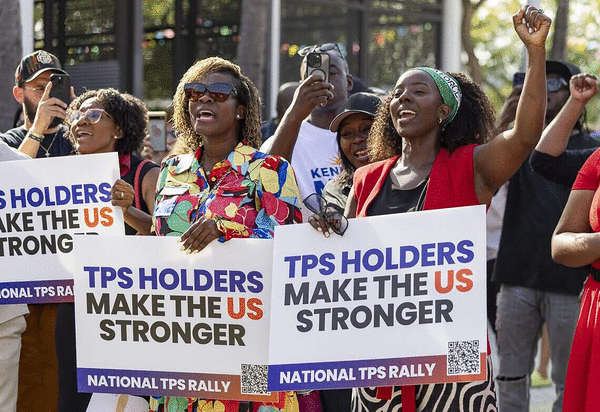
MIAMI — Hundreds of thousands of Haitian immigrants with Temporary Protected Status lost their strategic battle in June when the Supreme Court ruled the Trump administration’s decision to end that benefit on Friday, July 24, was not subject to judicial review.
But the legal war continues.
In a 6-3 ruling, the justices left open a narrow front for the 350,000 Haitians in the United States to continue challenging the administration’s decision based on their initial claim, which was filed in a District of Columbia lawsuit and says the decision was motivated by racial discrimination in violation of the Equal Protection Clause of the Constitution.
Haitians with TPS “still have a live constitutional claim, even following the Supreme Court’s decision,” both the plaintiffs’ and government’s lawyers agreed in a joint report filed on July 10 in the federal court in Washington.
Lawyers for the Haitian immigrants said they were “still evaluating the effects of the Supreme Court’s ruling” and would inform U.S. District Judge Ana Reyes by July 31 about filing an amended lawsuit.
To be sure, the six conservative justices ruled that President Donald Trump and then-Homeland Security Secretary Kristi Noem did not make public statements that might be considered discriminatory — despite the contrary views of the three minority justices. During his campaign for president in 2024, Trump falsely said Haitian immigrants in Ohio were eating pets and previously had called their country a “s---hole.” Last year, just after announcing the end of TPS for Haitian immigrants, Noem referred to them and other foreigners as “leeches.”
But it is possible the immigrants’ lawyers could uncover emails or other official documents showing racism might have been a factor in the Department of Homeland Security’s decision ending TPS for the Haitians, about one-third of whom are living in Florida.
For now, the Haitian immigrants’ case challenging the end of TPS — which had provided them with work permits and deportation protections — will have to be refiled in the Washington, D.C., federal court where it was originally brought a year ago. The new suit will undoubtedly be revised to focus only on the immigrants’ constitutional claim that racial discrimination drove the Trump administration’s decision.
But even as the Haitian immigrants’ TPS case moves through the federal court in Washington, many of them could still be deported by Immigration and Customs Enforcement. The Supreme Court’s decision now allows the Trump administration to strip protections from hundreds of thousands of Haitian immigrants and a few thousand Syrian immigrants.
TPS allows eligible nationals of specifically designated countries to remain in the United States and obtain work authorization due to unsafe conditions in their home countries. The Obama administration designated Haiti for TPS in January 2010 after an earthquake killed 316,000 people, as reported by the Haitian government.
But on June 25, the nation’s highest court paved the way for Immigration and Customs Enforcement to deport hundreds of thousands of immigrants from Haiti and Syria fleeing instability and violence in their home countries in a case about their deportation protections under Temporary Protected Status.
The six conservative justices found that the TPS statute is clear in that it prohibits judges from reviewing executive-branch TPS decisions that are unrelated to constitutional claims.
The TPS law allows “no judicial review of any determination” by the secretary of the Department of Homeland Security, Justice Samuel Alito wrote in the majority opinion.
At the same time, Alito also said the Haitian immigrants’ argument that the Trump administration terminated TPS because of race, violating the Constitution’s Equal Protection Clause, was “unlikely to succeed on the merits.”
“The sole constitutional claim before us will likely fail,” Alito wrote in the majority opinion as he rejected the argument that Trump and Noem made public statements about Haiti and its people suggesting the termination of the country’s TPS designation was based on the racial makeup of its population.
Trump has said falsely that Haitians eat dogs and cats. He has also said Haitians “all have AIDS” and has called Haiti a “s---hole” country, among other remarks.
Geoffrey Pipoly, an attorney who argued in the Supreme Court on behalf of Haitians, said the Supreme Court’s decision meant that the Trump administration can now “break the law flagrantly and openly and make no secret of it and the federal courts can’t stop it.”
But Pipoly also said the most surprising aspect of the decision was that it did not conclude Trump’s comments were based on racial discrimination. The majority opinion says “none of the cited statements either by the President or the Secretary was overtly racial.”
“The majority put blinders on to the evidence, and I think their outcome, like the government’s outcome, was preordained,” Pipoly said.
Strong dissent
Justice Elena Kegan wrote the dissenting opinion, saying that to “preclude review of those determinations is of course to insulate critical matters from judicial scrutiny.” Justices Sonia Sotomayor and Miami-raised Ketanji Brown Jackson agreed in the dissent.
Kagan also wrote that the argument that race had likely entered into the decision-making of the Trump administration was likely to succeed.
“The statements fairly shout, in their racial undertones and overtones alike, that race entered into the President’s resolve to remove Haitians from this country,” wrote Kagan, adding that TPS holders from Syria and Haiti should be allowed to stay while litigating their cases.
Kagan concluded: “[T]hey are entitled to that relief, and should not instead be consigned to devastating, and indeed life-threatening, injury.
The Supreme Court ruling stemmed from emergency requests that the Trump administration made to the court asking for the justices to end the protections for Haiti after lower courts ruled in favor of TPS holders. In the District of Columbia, federal Judge Ana Reyes said comments from Noem about Haitians showed prejudice.
In an 83-page opinion, Reyes said the plaintiffs were likely to prevail on the merits of the case — contrary to the ultimate ruling by the Supreme Court. She also found it “substantially likely” that Noem preordained her termination decision because of “hostility to nonwhite immigrants.”
The judge, an appointee of President Joe Biden, said Noem did not have “unbounded discretion” and was required to consult with other agencies on conditions in Haiti. The ruling cited Noem’s own words three days after announcing an end to Haitian protections last year, calling for a travel ban from Haiti and “every damn country that has been flooding our nation with killers, leeches, and entitlement junkies.”
In her order, Reyes blocked the Trump administration from deporting any Haitian immigrants with TPS — but it was violated by the government at least on one occasion.
In May, the administration deported a longtime Marathon resident with Temporary Protected status to Haiti despite Reyes’ order, which had kept the protections in place. but then it allowed him to come back to the United States two weeks later. Since the Supreme Court overturned her order in June, however, Haitian immigrants with TPS are now vulnerable for deportation — even while their constitutional case continues in her federal court in Washington.
The Trump administration first ended TPS for Haiti in February 2025, around the same time it also did for Venezuela. The Department of Homeland Security, then under Noem, argued that conditions in Haiti were safe enough for its nationals living in the United States to return despite ongoing extreme violence, widespread hunger and political instability.
At the same time, the State Department has said American travelers should not go to Haiti and supported the deployment of an international task force sent to suppress gangs in Haiti. The United Nations estimates that up to 90% of Port-au-Prince is controlled by gangs and that gang violence has killed over 2,300 people in Haiti since the beginning of this year.
—Miami Herald Staff Writers Jacqueline Charles and Syra Ortiz Blanes contributed to this report.
©2026 Miami Herald. Visit at miamiherald.com. Distributed by Tribune Content Agency, LLC.




Comments