California bill would make companies doing business in state disclose any slavery ties
Published in News & Features
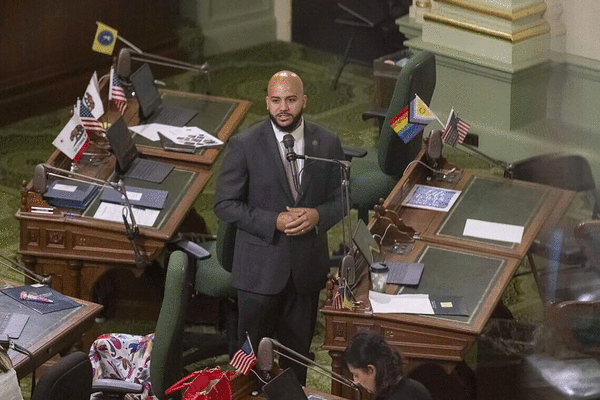
SACRAMENTO, Calif. — Major corporations that do business in California would be required to disclose any past connections to slavery under a measure that could pass the Legislature next month.
Assembly Bill 2599 would force companies that have more than $100 million in sales annually across the world to search through their records for evidence that they, their predecessors or subsidiaries previously bought or sold enslaved people or provided financial support for those transactions, such as through insurance or loans.
The corporations would need to submit sworn statements to the state confirming they searched through all of their records and could face legal action from the attorney general if they are found to have violated the measure.
“I think we should have a true and honest public accounting on the private wealth that’s been generated and extracted from our collective ownership of black bodies during chattel slavery,” its author, Assemblymember Isaac Bryan, D-Jefferson Park, told state senators during a committee hearing last month.
The bill follows the work of a first-in-the-nation task force that undertook a multi-year study to document harms committed against African Americans in California and detail ways to make amends, which were outlined in a lengthy report released in 2023. But the measure’s roots go well beyond the group’s work.
Bill passed in 2000 targeted insurance companies
In 2000, the Legislature passed a bill that required insurance companies in the state to disclose past policies they issued to slaveholders to cover the death or injury of enslaved people. The insurers also needed to make public details on the enslaved people and slaveholders who were involved in those policies. Records from that law are still available online.
Bryan’s bill faces opposition from an array of state and national insurance trade groups, including the American Council of Life Insurers. They say they appreciate what the measure is trying to do but argue that insurers should receive credit for the work they did to comply with the previous law, if the new measure goes into effect.
Christian Rataj, a senior regional vice president for the western region at the National Association of Mutual Insurance Companies, said in a statement that doing so “would only avoid needless duplicative reporting.”
The sworn statements required in the new bill would need to include the names of slaves and slaveholders, and corporations would also have to disclose any records showing they provided insurance coverage related to slaveholding and evidence of using enslaved people for collateral for policies or in other financial transactions, dating back to 1849. Companies would need to submit the information by next year. The measure wants the details to be publicly available by 2028.
So far, Bryan has not agreed to the request from the insurance groups, saying that their past work would give them a head start.
The bill would need to pass by Sept. 1 to go before Gov. Gavin Newsom. It was easily approved in the Assembly and needs to make it through another committee before facing a vote in the Senate.
Pro-reparations group has concerns about the bill
Chris Lodgson, a lead organizer for the Coalition for A Just and Equitable California, which advocates for monetary compensation to descendants of people enslaved in the United States, has other concerns about the measure. He questions what form of reparations the bill would actually provide.
The state has for decades had the information about the involvement insurance companies had in slavery.
“What has that produced? What has been the result of that?,” he said. “If the state wants to motivate corporations to pay what they owe, pay what it owes.”
The organization is not supporting or opposing the latest measure.
Bryan’s bill is much more expansive than the previous effort because it is not solely focused on one industry, and it also carries the threat of action by the attorney general, which could seek to require that companies follow the measure. It does not require that corporations pay any penalties for the information they disclose about their past.
“It’s, first, most important to have a true and honest conversation about where we are and how we got here,” he told senators during the hearing, “before we decide what that means and what responsibility we have to provide meaningful redress.”
____
©2026 The Sacramento Bee. Visit at sacbee.com. Distributed by Tribune Content Agency, LLC.






Comments