A wave of young Miami Cubans disagrees with abuela about politics in the Trump era
Published in Political News
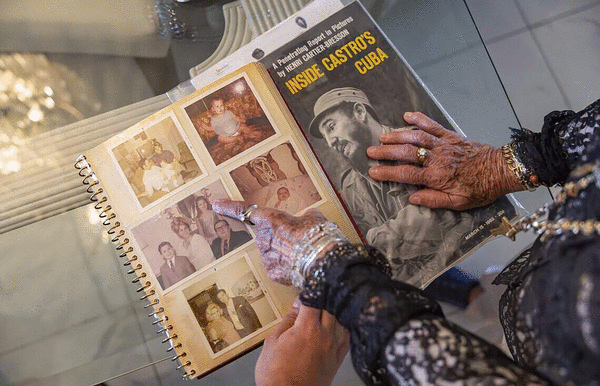
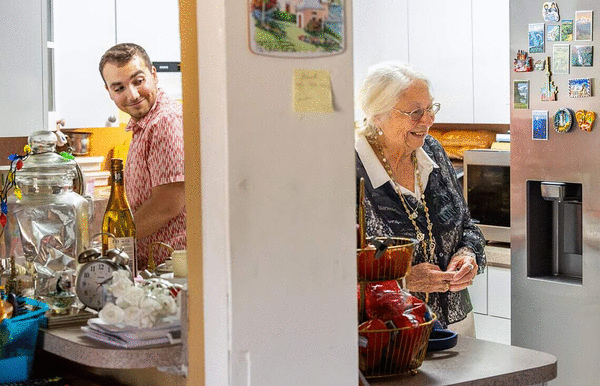


MIAMI — The warm and inviting living room of the Rosales family’s Kendall West home is decorated with intricately hand-painted egg shell dioramas. In a back bedroom, piles of old photo albums document the family matriarch’s youth in Cuba before she immigrated to Miami in the 1960s. A 1963 LIFE Magazine profile of Fidel Castro is buried in the memories.
Susie Rosales, 86, proudly shows her elegant wedding photos and raves about how the Cuba she was raised in was “paradise,” before the revolution. After she fled to Miami, she forbade her kids from ever visiting the island, her son’s children recounted.
But the youngest generation — Alberto, 23, and Maritere, 22 — still had relatives there on their mother’s side. They spent summers in Pinar del Río, visits that shaped political views that are softer than the hardline sentiment that bonds so much of Miami’s Cuban exile community.
“Half our family is over there so it feels like half of you is over there,” Maritere said.
The Rosales siblings say they oppose Castro’s power and the communist government like their relatives. But they see the decades-long U.S. sanctions and embargo as a failed policy, and are among a surprisingly large number of younger Cubans and Cuban Americans who recoil at the tactics the Trump administration is using against the teetering regime — views that have put them at odds with their own families on an issue that, in Miami, is a third rail.
According to a recent Miami Herald poll, the vast majority of Cubans and Cuban Americans in South Florida think the Cuban government is responsible for the humanitarian crisis on the island, where poverty is extreme and garbage burns in the street. But that number drops sharply among young adults: Almost half of respondents under 35 said the U.S. holds equal or greater responsibility for the conditions in Cuba.
The friction young critics say they have with their families only deepened this year when the Trump administration imposed a de facto oil blockade to further pressure the government to implement reforms, accelerating the island’s financial collapse and contributing to blackouts and total failure of Cuba’s power grid. Following the U.S. military’s snatch-and-grab of Venezuelan ruler Nicolas Maduro, “Cuba is next” has been a common refrain here and in Washington.
Trump has touted how popular his ruthless approach is in Miami — and indeed, 67% of South Florida Cubans and Cuban Americans said they approved of his U.S-Cuba policy in the Herald poll. But that number was heavily swayed by older respondents: More than half of young adults who will make up the future of Miami’s voting base disapproved of Trump’s actions.
“They definitely make their voices heard, which, good for them, but then it sort of creates a narrative,” Alberto Rosales said of Miami’s hardliners. “I don’t think any military action is going to be beneficial to any people living over there.”
Yiselys Soto, 31, was born in Cuba and moved to the U.S. with her family in the late 1990s when she was three years old. She said in her family, she feels like she is “one of the only people who has really tried to look beyond Cold War-era propaganda and the usual United States narratives about Cuba.”
Soto, who works in a psychiatric clinic, avoids fights with her family, particularly after getting responses like “college made you communist,” when she’s tried to argue her point of view that Cuba needs sovereignty, not U.S. military escalation, with her Trump-loving parents.
“It is isolating and at times, it can be a little scary,” Soto said. “This is kind of the hub of people who have that very pro-U.S. foreign policy mindset. So coming out against that does feel very intimidating.”
Older Cubans — especially those who arrived in the first waves between the 1950s and early 1970s — are still troubled by the expropriation of properties, religious persecution and political assassinations that marked the first years of the Cuban Revolution, according to Jorge Duany, a retired Florida International University professor.
“Those were the people who were most traumatized, most personally impacted by these abrupt changes. Those who arrived later often don’t even have memories of those early years of the revolution or the pre-revolutionary era,” said Duany.
But since the first waves of Cuban migration, deep ideological differences have existed in the Miami Cuban community. Some supported the ousted dictator Fulgencio Batista, and others opposed him. There were also progressive organizations, influenced by the civil rights and anti-war movement of the 1970s. Brigada Antonio Maceo, deeply sympathetic of the Castro regime, pushed for the normalization of relations between Cuba and the U.S.
“The community has always been divided by these topics, and those divisions have coincided greatly with generational differences,” Duany said.
Fernand Amandi, whose polling business Bendixen & Amandi International surveyed 800 Cubans in April for The Miami Herald, said his polling revealed a more militaristic diaspora now than during the Barack Obama administration, when Cuban Americans were more open to normalizing relations with Cuba.
Obama won 52% of Cuban voters in Miami-Dade County during his 2012 reelection bid, and later moved to thaw the U.S.-Cuba relations. He eased sanctions on travel, trade and transactions as Embassies reopened in Havana and Washington D.C. after 54 years.
At that time, sentiments were “very much against continuing the embargo, much more for unlimited travel to Cuba, much more on the ideas that economic reform could eventually lead to a set of circumstances where capitalism would overtake communism,” Amandi said.
“Those attitudes have shifted,” he added, attributing the change to Cuba’s failure to enact democratic reforms.
Obama’s Cuba rapprochement didn’t last; Donald Trump changed course in a Little Havana ceremony early in his first term as president. Instead, what endured was the image of Raul Castro grabbing Obama’s arm in an awkward, unreciprocated gesture of triumph, and of the two men attending a ballgame in Havana.
“You will no longer have to witness the embarrassing spectacle of an American president doing the wave at a baseball game with a ruthless dictator,” Republican Miami Congressman Mario Díaz-Balart said during the Miami ceremony where Trump turned away from many of the Obama administration’s changes.
In the decade since, as conditions in Cuba have deteriorated and with Trump’s rise back to power, some Cuban voters have taken a hard right turn.
And when Trump’s attorney general came to the Freedom Tower in May to announce the indictment of now-95-year-old Raul Castro in the deadly shootdown of two Brothers to the Rescue planes, the historic building was packed.
Former Miami Mayor Tomás Regalado says the hard-line stance of the older respondents in the Herald poll could point to older Cubans witnessing decades of U.S.-Cuba negotiations with no change to the island’s leadership.
Regalado, 79, came to the U.S. with his younger brother in the 1960s through the Catholic Church’s Pedro Pan program, and saw first-hand the attempts of Presidents Jimmy Carter, Bill Clinton, and Obama to broker deals with Havana.
“As a diaspora, we have become convinced that you can’t negotiate with that regime because it has no will to negotiate and because all they want is to cling to power, expel those who don’t express their opinions, or simply beat those in the streets who aren’t lucky enough to leave the country,” said Regalado, now the county’s elected property appraiser.
Records showing the Cuban government has secretly stockpiled cash as people on the island cook their food over firewood has only deepened the sentiment that the government in Havana must go.
But some young Cuban-American critics in Miami say a singular focus on the Cuban government overlooks the effect of a punishing U.S. embargo dating back decades, preventing nearly all trade with the island, with exemptions for food and medicine.
“It is dishonest to talk about Cuba’s problems without talking seriously about the U.S. embargo and sanctions. Those policies shape the entire economic reality of the island,” said Soto, the Miami resident who left Cuba at a young age. “You cannot separate many of the Cuban government’s failures from the enormous financial pressure Cuba has been under for decades.”
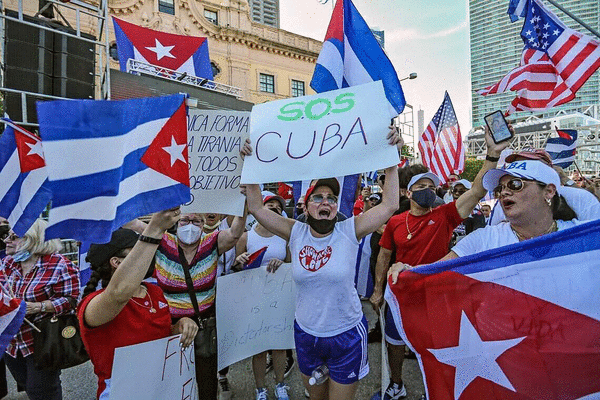
When Miami Cubans and Cuban Americans flocked to the Freedom Tower in July 2021 in support of the massive political protests on the island against Castro and the communist government, then-teenagers Alberto and Maritere Rosales were excited to attend in solidarity.
Standing in the crowd, they heard messages they agreed with: calls for freedom and a better life for their Cuban relatives still on the island. But they were stopped in their tracks, looking at each other uncomfortably as a speaker on the megaphone shouted, “We call for direct intervention now!” and the crowd erupted in cheers.
That moment still sticks in the siblings’ minds as indicative of the complex political landscape growing up Cuban American in Miami — where hard-line Cuban exiles have solidified their political power and called on the U.S. government to force political change in Cuba, even if it causes suffering.
When it comes to Trump’s hard-line policies: “Those that suffer most are el pueblo, and 90 miles away this is a geopolitical game for the Cuban Americans in Miami,” Alberto Rosales said.
The younger Rosales’ views are partly shaped by the siblings’ annual summers in Cuba, after which they’d tell their relatives in Miami how beautiful the landscape on the island was, but were quickly shut down and told not to talk positively about Cuba.
“The politics even affects the way you talk about the island, you talk about the nature, the people — it affects everything,” Alberto said.
About 51% of respondents under 35 disapproved of the recent Trump administration policies restricting or limiting oil shipments to Cuba, according to The Miami Herald poll. Less than 30% of respondents over that age disapproved of such policies.
Rosales and his sister say they’ve found communities of other young people in Miami who agree with them, but that broaching conversations about politics at family gatherings — and fighting to change the narrative about what it means to be a Miami Cuban — remains uncomfortable.
“I don’t think anybody wants to get into an argument with their family,” he said. “Especially about something so touchy like this.”
©2026 Miami Herald. Visit miamiherald.com. Distributed by Tribune Content Agency, LLC.







Comments