Sarah McLachlan is mad as hell: 'I've had a lot of anger. Singing … is incredibly cathartic'
Published in Entertainment News
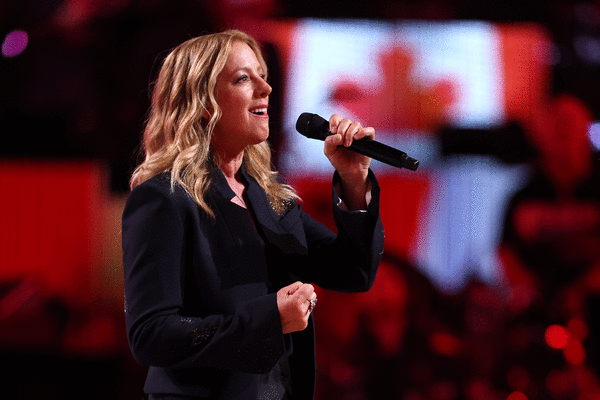
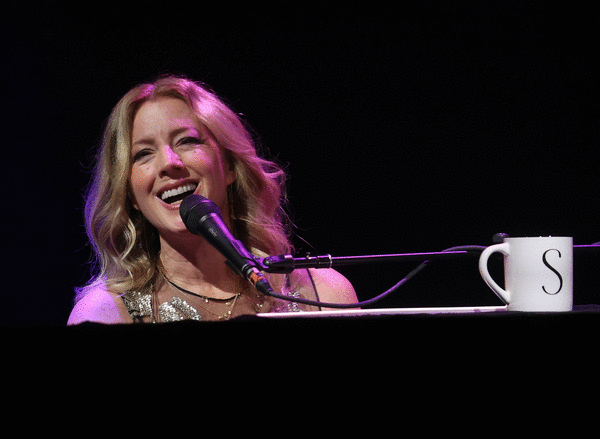
SAN DIEGO — As a Nova Scotia native and longtime Vancouver-area resident, Sarah McLachlan is well aware of the growing tensions between the U.S. and her Canadian homeland. She is also confident her music can help unify listeners on both sides of the border and beyond.
“A lot of people have said to me: ‘Why are you going to America? Why are you performing in America? You shouldn’t.’ Because I’m a, you know, (Canadian),” McLachlan said, speaking from her home on Vancouver Island.
“But music spreads joy and love and inclusivity, and it builds bridges. So, for me, I want to come and help if I can — in some small way — bring people together and remind us of our shared humanity.”
Bringing people together and celebrating inclusivity has been a mission statement for McLachlan for much of her career, both before and after the 1997 launch of her groundbreaking Lilith Fair music festival that championed women artists.
A similar air of celebration is likely at stops on her summer tour with fellow Canadian troubadour Allison Russell promoting “Better Broken,” McLachlan’s first album of new songs since 2014’s “Shine On.”
As its title implies, “Better Broken” finds hope in the challenges of everyday life and a chaotic world that feels increasingly unhinged. Its best songs find McLachlan deftly confronting sobering topics, from the alarming and seemingly nonstop attacks on women’s rights (the stirring “One In a Long Line,” which features her two daughters on harmony vocals) to the potential for an apocalypse that would end life on Earth as we know it (“If This Is the End”).
“One In a Long Line” also has the distinction of being McLachlan’s first song since “Building a Mystery” in 1997 to include a four-letter epithet that rhymes with “muck.” Her use of the word points to the righteous anger she felt when she wrote “One In a Long Line,” which was inspired in part by the Supreme Court’s 2022 decision that overturned Roe v. Wade and eliminated the federal constitutional right to abortion.
“Yeah, I’ve had a lot of anger, fear and frustration over what’s been going on — not just in America and North America — but all over the world, with the clawing back of women’s rights and human rights,” McLachlan said.
“It’s incredibly frustrating to see the advances of the women who came before me and worked so hard to (achieve), and some of the men, too, just getting eviscerated so easily (with) these horrible steps backwards.”
Yet, while the song leaves no doubt about her anger and dismay, “One In a Long Line” also contains unmistakable defiance and hope in the face of adversity. Witness such steadfast couplets as: I am a wildfire, I am a forest burned/ But I will rise, you’ll see/ And if you think that you can bring me down/ Well, go ahead and call the cavalry.
‘Incredibly cathartic’
“I was, and am, angry,” McLachlan affirmed. “But I need a place to put these things, so they’re not making me lose my mind every day. Because there are certain things you can control — and so many things we can’t. My whole thing with writing that song was finding a place to put it where I could process some of it. And I will say that singing that song live is incredibly cathartic.
“It’s one of the only songs where I get physically pissed off performing it, because (these things are) still happening. It’s not like a love song, where there’s loss or whatever, and you know that — a year after you write the song — there’s some objectivity and some space from it. This feels like we’re living it, right now. And there’s a real visceral response that happens to me, which is a new feeling for me, that is good and bad. Because it takes me a moment after finishing that song just to come back down again.”
“Better Broken” is McLachlan’s first album since her 1988 debut, “Touch,” to not be produced by Pierre Marchand. Instead, she teamed up with Tony Berg and Will Maclellan, who have previously collaborated on albums by Bruce Hornsby, Phoebe Bridgers, Lorde, Boygenius and Switchfoot.
The result is a work that remains rooted in McLachlan’s warm, inviting songcraft. It also boasts some contemporary touches that give her music a fresh sonic sheen, without diluting the essential ingredients in her music.
Was this new partnership a deliberate effort to move out of her comfort zone?
“Absolutely, yeah,” McLachlan said. “I kind of felt like I was cheating on Pierre! I’ve worked with him for so many years, and I adore him and love what we created together. But I thought at the time this might be my last record. And if that were the case, I owed it to myself to try and step out of my comfort zone — as you said — to try something different, and I’m very glad I did.
“Pierre gave me his blessing and that freed me to step fully into this new relationship. We had the best time making music. We were all in the studio, every day, having the best time laughing our asses off while making the saddest music ever. Perfect!”
Lilith Fair, meet Olivia Rodrigo
The release of her “Better Broken” album last September came just two days after the premiere of the documentary film “Lilith Fair: Building a Mystery.” It features McLachlan and such fellow Lilith alums as Bonnie Raitt, Emmylou Harris, Tracy Chapman, Jewel, Sheryl Crow, Erykah Badu, Brandi Carlile, Liz Phair and the Indigo Girls.
The movie also includes 23-year-old Olivia Rodrigo, who was born six years after Lilith Fair’s 1997 debut. On Aug. 29, Rodrigo will headline the inaugural edition of Daisy Chain Fields, a new music festival she is curating at Great Park in Irvine.
The female-led lineup includes McLachlan, Stevie Nicks, Chappell Roan, Doechii, Bikini Kill, Garbage, the Breeders and more. All of the net proceeds from Daisy Chain Fields will go to nonprofit organizations that advance and advocate rights for girls and women.
“Lilith Fair was a huge inspiration in me starting this festival, Daisy Chain Fields,” Rodrigo said in a June “Good Morning America” interview on ABC. “And actually, the first person that I called when I decided that I wanted to do this festival was Sarah McLachlan.”
McLachlan was interviewed by the the Union-Tribune a week before Rodrigo’s festival was announced. She spoke with palpable pride about the Lilith Fair documentary and the festival’s enduring impact.
“I think the film is beautiful,” she said. “And it’s a really great reminder of the power that people have, the power that women have, when they build systems that support each other. That’s a really powerful message that needs to be told even more (now). It’s even more prevalent today than perhaps it was then, because of the way things are being clawed back, so you know, most I’m just, I’m incredibly proud that I got to be part of that.
“It was challenging for me back then to understand all the complexities of the general culture being what it was, and why even some women didn’t want to be part of (Lilith). There was such a pervasive male culture of dismissing women, in all sorts of ways, in any kind of position of power, financial power, emotional power. All those things were kind of written off. It was like: ‘You’re too big, you’re too small, you’re too loud, you’re too quiet, you wear too much makeup, you don’t wear enough makeup…’ Every time any we want to take up any space, there was this constant challenge, which was just really, really annoying, and I guess it’s still happening.”
McLachlan is quick to note that, while there have been major advances, some pervasive challenges continue largely unabated.
“I think there’s been a lot of great strides made,” she said, “in particular in the music industry, where you look at the charts being dominated by women and Taylor Swift being the biggest artist of all time. The way she’s using her platform is incredible.
“So, yes, great strides have been made. That being said, there’s, there’s always this cyclical thing when a group, a marginalized group, (gets) too much power, then the old white men who have been holding onto the power feel threatened and need to try and hold on to that power. So, that’s that’s that contraction point that we’re in right now that is happening. But I think we all need to be reminded that we do have power, and we particularly have power when we work together.”
This interview has been edited for length and clarity.
Q: Duke Ellington, who was a very prolific composer, was once asked what inspired him to write music. He smiled and said: “Give me a deadline!” Bearing in mind “Better Broken” is your first album in 11 years, and that you were working on it when we last spoke in early 2020, how important are deadlines to you?
A: They are often quite important. But I didn’t have any deadlines on this record. That’s probably why it took 11 years — and life continued to intervene. But yeah, I do enjoy deadlines. I mean, they piss me off, too, but they do help, for sure.
Q: Why did you think “Better Broken” would be your last album? And have you, I hope, changed your mind?
A: Yes, and yes, I think that was because it took 11 years to get to this place, and I was thinking: “Do people even make records anymore?” And also, making a record for me usually equates to leaving (home), and I’ve become a real homebody, I hate to leave my kids, my dogs and my life that I’ve created here. That’s part of it. The fact that I can still do this, after 40 years, is such a luxury, and I’m certainly not complaining. But being gone for big chunks of time, there was some trepidation there. Now that I’ve done it, I was reminded of how joyful the process is. I can’t wait to get back in the studio again and continue to make music.
Q: When we last spoke in early 2020, it was less than two months before the pandemic shutdown and you were at work on what became “Better Broken.” How did the album change and evolve as a result of the pandemic, and the world coming to a horrendous standstill? I have to assume there was some cause and effect there.
A: It certainly slowed everything down. And being creative came to a grinding halt for me. Like many of us, I went into survival mode, not knowing what was coming next, not knowing if half the population in the world was going to perish or what was going to happen. So, it took a while to settle into that new normal. I didn’t even play (music) for about two years, which is weird.
Coming out of it, I initially felt hopeful that this would bring us all together. Then, to just watch that unravel… there was some sadness attached to that. But I’m an optimistic person by nature, and I am always constantly looking for the silver lining and recognizing that I can only create change where I have some power to do so. And so, that’s what I continue to do…
Writing songs is extremely cathartic for me. And writing has always been a way for me to process challenging emotions, or frustrations, or loss, or grief, or joy, which is not so easy to write about. Maybe another reason it took me 11 years to make this album is that I was, you know, pretty happy!
Q: There are albums in an artist’s career that are a demarcation point, where one phase of their career concludes and then they started something really different and new. For example, Tom Waits, when he made his “Swordfishtrombones” and “Rain Dogs” albums. “Better Broken” is not such a dramatic departure from what you did before it, but it does have some fresh twists. Does this feel like a demarcation point for you?
A: Yeah. I agree that it’s still inherently me and there are a number of songs that are more traditional piano ballads. But there’s a real earthy groove and vibe that Tony and Will created that I didn’t know my music was capable of. That’s the joy of collaboration and being with great musicians and great producers. I write a song in isolation by myself, and I get it to a point where I’m happy in a very simplistic manner. Then, the real fun starts when you get into the studio, and you bring in a bunch of great people who take the song to places you never would have imagined it being able to go. That was one of the most fun parts for me.
Q: I referenced our 2020 interview. Previous to that, we spoke in 2010 when you were doing the 2010 Lilith Fair tour, and you said: “I do feel Lilith broke down some boundaries. We also dispelled the misconceptions that women can’t play together and that people won’t come to see them, which was an asinine assertion. Lilith proved something to the music industry, but I’ve always been a reluctant spokesperson. I’m less comfortable talking about whether Lilith was feminist enough; that became tiresome. Have you revaluated it, particularly with the Lilith movie? And do you look at it a new way now, through the lens of the film?
A: Yeah. Having perspective and time, recognizing the magnitude of what was created by this simple idea of women coming together and celebrating each other and celebrating their successes, and the fact that that was so threatening is crazy. And I felt that way then,
Q: With Bonnie Raitt and Emmylou Harris having been part of the first Lilith tour, I’m wondering if — either through conversation or just by their example — did you look directly or indirectly learn something from them, given that they had come before you and experienced things years earlier that you were probably experiencing as well?
A: Absolutely, yeah. And it was not lost on me that these women had come up in the industry, and in the world, in a time where women were not doing what they were doing. So, the things that they had to fight against were exponentially harder than where we were at that time. And I remember, and it’s funny because it was in the film, where I said at one point during the (daily pre-Lilith) press conferences — which were incredibly painful, because we were constantly besieged with “You’re too this, you’re not enough of this”; “Why are you doing this?” “Why do you hate men?” — and it just all baffled me.
Because I’m like: “What does celebrating women have to do with anything? Why is there anything negative attached to any of this?” But at one point I did say: “Oh, you know, we’re we’re probably gonna include men” (in the next Lilith lineup).” Emmylou took me aside, and said: “What are you doing? This festival is in its infancy, and it’s beautiful what you’re creating — what we’re all creating here — and let it let it happen.”
And I was like: “Thank you.” When everybody was challenging me, saying: “You should do this, you should do that, why don’t you do this?” I kind of had a weak moment. And Emmylou reminded me again of the power, the inherent power, of what we were doing together when I had lost a bit of perspective. And I remember Bonnie Raitt said: “This is the best tour (I've) ever been on.”
Q: Could Lilith Fair return?
A: I still get asked daily: “Would you bring Lilith back? Do you feel this is a good time to bring Lilith back?” Now, more than ever we need opportunities to remind people of their shared humanity and that diversity is a beautiful thing and that great things can happen. I would love to be part of that, if someone else did it. I’ve already done that.
Q: Your new song, “One In a Long Line,” very effectively uses the word “f—,” which you had not had one on of your albums in nearly 30 years. I don’t know if you read Linda Ronstadt’s 2022 book, “Feels Like Home,” but she used the same word — just twice — and it was more impactful because it was only those two times. When I asked Linda if she used the f-word much in her day-to-day life, she playfully replied: “I use the word as a noun, a verb, and an adjective.” Would that apply to you, too?
A: Yeah, I use it. I have these coffee mugs that say: “F—, off.” I have a great picture of my 98-year-old stepmother, who just recently passed, and my favorite auntie, and they both had their “F— off” mugs! It’s a great word, and it should be used properly. When it’s every second word and gratuitous, it does lose its value. But it seemed very appropriate for that moment (in the song) and for how I felt.
Q: We live in challenging and surreal times. Does music mean anything more, or different, to you now than it did in 1989, or in 2019?
A: If anything, it’s become more powerful for me as a means to be myself in the world, to be of service and be of use, and feel purposeful. Music is such a bridge-builder and connector, and it reminds us of our shared humanity. When you go to a show, a live show, it’s one of the last places where people can come and connect on a really visceral emotional level, put aside their differences for a few brief moments and just be together, be open, be vulnerable, and just feel.
That’s so important, especially these days, when we’re being challenged, pulled apart and pulled in so many different directions. Everything is gearing us to dislike and fear each other, instead of finding ways to connect and remain close to each other. Because as humans we cannot exist alone, we can’t exist in a vacuum.
We need each other. And music is even more important than it ever has been, for me anyway, to feel purposeful, to feel like in some small way, if I can create a connection with people where they might not have that otherwise, that feels powerful. And it feels like it’s the thing that I can do to help make a positive difference.
©2026 The San Diego Union-Tribune. Visit sandiegouniontribune.com. Distributed by Tribune Content Agency, LLC.




Comments